
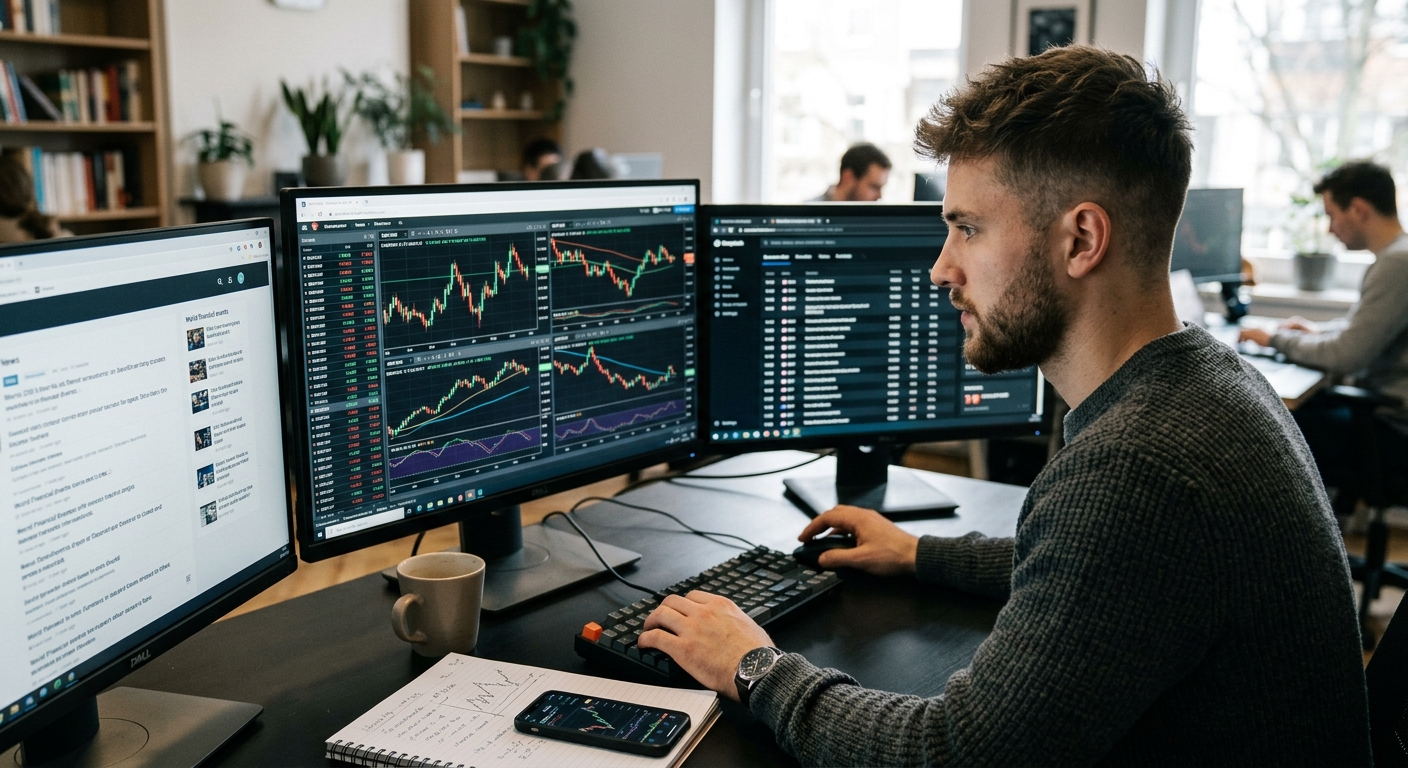
What Is Foreign Exchange Trading? Information To Foreign Exchanges
Foreign exchange trading is the process of buying and selling currencies in the global foreign exchange market. It is commonly known as forex trading or FX trading.
The market exists because currencies are needed for international commerce, investment, tourism, cross-border payments, and financial risk management. A company importing goods from another country may need to convert its domestic currency into the currency of its supplier. An investor purchasing foreign assets may also need to exchange currencies. Banks facilitate these transactions, while traders and institutions may speculate on changes in exchange rates.
Forex trading is therefore not a single activity performed for one reason. It encompasses commercial transactions, hedging, investment, and speculation.
The market is also unusually international. Trading activity moves between major financial centers in Asia, Europe, North America, and elsewhere. There is no single global forex exchange equivalent to a centralized stock exchange.
For those trying to understand foreign exchange markets, one question quickly becomes important: when is the market most active?
Understanding the best time to trade currency requires knowledge of global trading sessions, liquidity, volatility, economic announcements, and the particular currency pairs being traded.
What Is Foreign Exchange Trading?
Foreign exchange trading involves exchanging one currency for another.
Currencies are quoted in pairs because one currency is always valued relative to another.
For example:
EUR/USD = 1.1000
This means one euro is worth 1.10 U.S. dollars at the quoted exchange rate.
A trader expecting the euro to strengthen against the dollar might buy EUR/USD. A trader expecting the euro to weaken against the dollar might sell the pair.
The trader’s eventual profit or loss depends on the movement of the exchange rate, the size of the position, and applicable trading costs.
These costs may include spreads, commissions, financing charges, and other broker fees.
The basic mechanism is straightforward.
The factors that cause currency prices to change are considerably more complicated.
Why Are Currencies Traded?
Foreign exchange exists primarily because the international economy requires currencies to be converted.
Consider an Indonesian company purchasing equipment from Germany.
The Indonesian company may earn revenue in rupiah but need euros to pay the German supplier. A currency transaction is required.
Similarly, an American company receiving revenue from Europe may receive euros and later convert those funds into U.S. dollars.
Banks facilitate enormous quantities of such transactions.
Governments, central banks, investment institutions, multinational companies, hedge funds, and retail traders also participate in foreign exchange markets.
Their objectives differ.
A corporation may be hedging currency risk.
A central bank may be managing monetary conditions.
An investment manager may be adjusting international portfolio exposure.
A retail trader may be speculating on a short-term movement.
The same market accommodates all of these activities.
How the Forex Market Works
Unlike most major stock markets, forex is predominantly an over-the-counter market.
There is no single worldwide exchange where every forex transaction occurs.
Instead, trading takes place through an interconnected network of banks, financial institutions, brokers, electronic trading systems, and other market participants.
This decentralized structure helps explain why forex can operate continuously across the global business week.
When financial markets in one region become less active, another major financial center may be opening.
The major trading regions are commonly grouped into:
- Asian session
- European session
- North American session
These labels are useful approximations rather than rigid boundaries.
Financial activity can overlap considerably between regions.
Understanding Currency Pairs
Forex traders do not simply buy “the euro” or “the dollar.”
They trade currency pairs.
The first currency is the base currency.
The second is the quote currency.
Consider GBP/USD.
GBP is the base currency.
USD is the quote currency.
If GBP/USD rises, the pound has appreciated relative to the dollar under that quotation.
If GBP/USD falls, the pound has depreciated relative to the dollar.
This relative structure is fundamental to foreign exchange.
A currency can strengthen against one currency while weakening against another.
That is because exchange rates measure relationships rather than absolute values.
Major Currency Pairs
Major currency pairs generally involve heavily traded currencies and usually include the U.S. dollar.
Common examples include:
- EUR/USD
- GBP/USD
- USD/JPY
- USD/CHF
- AUD/USD
- USD/CAD
- NZD/USD
These pairs typically attract significant trading volume.
Greater liquidity can result in tighter spreads and more efficient execution under ordinary market conditions.
However, liquidity is not guaranteed at every moment.
Economic announcements, market shocks, holidays, and unusual events can alter trading conditions.
Minor and Exotic Currency Pairs
Currency pairs that do not include the U.S. dollar are often called minor or cross pairs.
Examples include EUR/GBP and EUR/JPY.
Exotic pairs generally combine a major currency with the currency of an emerging or smaller economy.
Examples can include USD/TRY and USD/ZAR.
Exotic pairs may offer substantial price movement, but they can also involve wider spreads, lower liquidity, and greater volatility.
The apparent opportunity therefore needs to be considered alongside the associated costs and risks.
What Causes Exchange Rates to Change?
Currencies respond to economic expectations and capital flows.
Several factors are particularly important.
Interest Rates
Interest-rate differentials can strongly influence currency markets.
If investors expect one central bank to maintain higher interest rates than another, expectations about relative returns may influence demand for the corresponding currency.
However, the relationship is not mechanical.
Markets frequently price expectations before a central bank actually changes rates.
Inflation
Inflation affects purchasing power and monetary policy.
Unexpected inflation data can change expectations about future interest rates, which can then influence exchange rates.
Economic Growth
Gross domestic product, employment, industrial production, consumer spending, and other economic indicators can affect perceptions of economic strength.
A stronger economic outlook can influence capital flows.
Central-Bank Decisions
Central banks are closely monitored by currency traders.
Interest-rate decisions, policy statements, forecasts, and speeches can all affect exchange rates.
Sometimes the language surrounding a decision moves markets more than the decision itself.
That is because financial markets constantly attempt to anticipate future policy.
Geopolitical Events
Elections, conflicts, sanctions, trade disputes, diplomatic tensions, and political instability can create sudden currency movements.
Such events can also produce significant volatility when they are unexpected.
Market Sentiment
Currency markets are influenced by investor psychology.
During periods of uncertainty, investors may move toward assets or currencies perceived as safer.
During periods of optimism, capital may move toward riskier assets and currencies.
Sentiment can therefore produce movements that are difficult to explain through a single economic statistic.
Forex Trading Sessions
One of the most useful concepts for understanding market timing is the trading session.
The global forex market moves through different financial centers as the day progresses.
The main sessions are generally described as:
Asian Session
The Asian session includes major financial centers such as Tokyo, Singapore, Hong Kong, and others.
Currencies associated with the region, particularly the Japanese yen, can receive greater attention during this period.
Trading conditions may vary considerably depending on the day and the prevailing economic calendar.
European Session
The European session is centered around major financial markets such as London and Frankfurt.
London is particularly important to global foreign exchange activity.
The European session often experiences significant liquidity and trading activity.
North American Session
The North American session is dominated by financial centers such as New York.
The session can be particularly active when it overlaps with European trading hours.
This overlap is important for traders monitoring major currency pairs.
What Is the Best Time to Trade Currency?
There is no single best time to trade currency for every strategy or every trader.
The most suitable period depends on the currency pair, strategy, market conditions, and tolerance for volatility.
However, some periods tend to offer greater liquidity.
One of the most significant is the overlap between the European and North American sessions.
During this period, major financial centers in Europe and North America are simultaneously active.
More market participants can mean greater trading activity and, under normal circumstances, potentially tighter spreads.
This can be particularly relevant for major pairs such as EUR/USD and GBP/USD.
But high activity is not automatically better.
More volatility can also mean larger and faster price movements.
For a short-term trader, that may create opportunities.
For a risk-averse participant, it may increase unwanted exposure.
The European-North American Overlap
The European-North American overlap is often considered one of the most active periods of the forex day.
This is partly because London and New York are both operating simultaneously.
Major economic announcements from the United States and Europe can also occur during this broad period.
The combination can create heightened liquidity and volatility.
However, traders should distinguish between liquidity and profitability.
A liquid market may provide efficient execution.
It does not guarantee that a particular trading strategy will make money.
When Currency-Specific Timing Matters
The most appropriate trading period can depend heavily on the currency pair.
A trader focusing on USD/JPY may pay close attention to Asian market hours and events affecting Japan and the United States.
Someone trading GBP/USD may place greater emphasis on European and North American sessions.
AUD-related pairs may be particularly sensitive to developments occurring during Asia-Pacific hours.
Therefore, a generalized statement about the best trading time can be misleading.
The more useful question is:
When is the particular currency pair most liquid and most responsive to the market factors relevant to the strategy?
Economic News and Forex Timing
Timing also matters because major economic releases can create abrupt movements.
Important announcements include:
- Central-bank interest-rate decisions
- Employment reports
- Inflation figures
- GDP releases
- Retail-sales data
- Manufacturing indicators
- Consumer-confidence reports
- Trade data
A currency pair can move substantially within seconds of an important announcement.
Spreads can also widen.
Orders may be executed at prices different from those expected.
This phenomenon is sometimes described as slippage.
Traders therefore need to understand the economic calendar before entering positions, particularly if their strategy is sensitive to short-term volatility.
Why Liquidity Matters
Liquidity refers broadly to the ability to buy or sell an asset without causing substantial price disruption.
High liquidity can offer several practical advantages.
Orders may be easier to execute.
Spreads may be narrower.
Price discovery can be more efficient.
Major currency pairs typically have deeper liquidity than less frequently traded exotic pairs.
But liquidity varies over time.
A market may become thinner during certain holidays or outside the most active trading periods.
This can affect execution conditions.
Spreads and Trading Costs
The spread is the difference between the bid and ask price.
For example:
EUR/USD
Bid: 1.1000
Ask: 1.1002
The difference is two pips under conventional quotation.
Although the spread may appear small, frequent trading can make transaction costs significant.
A trader making many short-term trades must account for the cumulative effect.
Other costs can include:
- Commissions
- Overnight financing
- Currency conversion fees
- Withdrawal charges
- Other broker-specific costs
A trading strategy should therefore be evaluated after costs rather than simply based on theoretical price movements.
Leverage in Foreign Exchange Trading
Leverage allows traders to control a larger position with a smaller amount of capital.
It is one of the most consequential features of retail forex.
Consider a simplified example.
A trader deposits $1,000 and uses leverage to control a position substantially larger than that amount.
If the currency moves favorably, the return relative to the deposited capital can be significant.
If the market moves against the trader, losses can accumulate just as rapidly.
Leverage does not reduce risk.
It increases exposure.
For this reason, understanding margin requirements and potential losses is essential.
Forex Trading Strategies
Different traders approach the market on different time horizons.
Scalping
Scalpers attempt to capture very small price movements over short periods.
Because individual gains can be small, transaction costs and execution quality are particularly important.
Day Trading
Day traders generally open and close positions within the same trading day.
They may use technical analysis, economic news, market structure, or a combination of approaches.
Swing Trading
Swing traders generally hold positions for several days or weeks.
Their objective is often to capture larger market movements than scalpers or traditional day traders.
Position Trading
Position traders take longer-term views.
They may base decisions on macroeconomic trends, monetary policy, economic cycles, or long-term valuation considerations.
There is no universally superior timeframe.
The appropriate choice depends on the trader’s objectives, resources, and risk tolerance.
Fundamental Analysis in Forex
Fundamental analysis examines economic conditions that influence currencies.
A trader may compare:
- Interest-rate expectations
- Inflation
- Economic growth
- Employment
- Government policy
- Trade balances
- Political stability
The key is often comparison.
If the U.S. economy is expected to grow more strongly than the eurozone, that may influence expectations for EUR/USD.
But the market may already have incorporated those expectations into the current exchange rate.
This is why forex analysis can be difficult.
Markets react not merely to facts but to differences between expectations and reality.
Technical Analysis
Technical analysis focuses on price behavior rather than primarily examining economic fundamentals.
Traders may use:
- Moving averages
- Trend lines
- Support and resistance
- Momentum indicators
- Volatility measures
- Chart patterns
Technical analysis can help structure a trading plan.
It cannot eliminate uncertainty.
A chart pattern is a historical observation, not a guarantee of future behavior.
Risk Management
Effective risk management is central to foreign exchange trading.
A trader should understand the maximum potential loss associated with each position.
Risk controls can include:
- Limiting position size
- Reducing leverage
- Setting predefined exit points
- Maintaining adequate margin
- Avoiding excessive concentration
- Monitoring correlated currency pairs
- Establishing daily or weekly loss limits
The objective is not to avoid every losing trade.
Losses are unavoidable in speculative trading.
The objective is to prevent individual mistakes or adverse market movements from becoming financially catastrophic.
Choosing a Forex Broker
A broker provides access to the trading environment, making broker selection an important consideration.
Factors worth examining include:
Regulation
Identify the regulator and legal entity responsible for the account.
Fees
Review spreads, commissions, financing charges, and other costs.
Execution
Understand how orders are processed and whether slippage may occur.
Trading Platform
The platform should be stable, functional, and appropriate for the intended trading style.
Client-Fund Protection
Understand how customer funds are held and what protections may apply.
Available Markets
Check whether the broker provides the currency pairs and trading instruments required.
A broker’s regulatory environment can be particularly important when trading across borders.
Overseas Foreign Exchange Markets
The international nature of forex provides substantial market reach.
However, overseas trading should not be interpreted as an absence of regulation.
Financial institutions and brokers generally operate under the laws and regulatory requirements of particular jurisdictions.
These rules can differ.
Leverage limits, investor protections, reporting obligations, product availability, and dispute-resolution mechanisms may vary depending on where a financial service is provided.
A trader considering an overseas broker should therefore investigate the legal entity, regulator, terms of service, and applicable protections carefully.
Convenience should not outweigh due diligence.
Forex Compared With Stock Trading
Forex and stock trading have several fundamental differences.
A stock represents an ownership interest in a company.
A currency represents value relative to another currency.
Stock markets commonly operate through centralized exchanges.
Forex is predominantly OTC.
Stocks may provide dividends.
Currencies generally do not generate dividends in the same manner, although interest-rate differentials and financing arrangements can affect the economics of holding currency positions.
The analytical frameworks also differ.
Stock investors may focus heavily on company earnings, valuation, management, and industry conditions.
Forex traders often focus more heavily on macroeconomics and relative monetary policy.
Common Mistakes Among New Forex Traders
Several mistakes appear repeatedly.
Excessive Leverage
Using too much leverage can turn a modest price movement into a large account loss.
Trading Without a Plan
Entering positions based on impulse makes consistent evaluation difficult.
Ignoring Economic News
Major announcements can dramatically affect exchange rates.
Overtrading
More trades do not necessarily mean more opportunities.
Transaction costs can accumulate quickly.
Chasing Losses
Attempting to recover losses immediately can lead to increasingly aggressive decisions.
Treating Historical Results as Guarantees
A strategy that performed well previously may not perform similarly in different market conditions.
How to Approach Forex Trading Responsibly
A disciplined approach starts with education.
Understand currency pairs.
Learn how spreads and commissions work.
Understand leverage and margin.
Study market sessions.
Learn how economic announcements affect volatility.
Understand broker regulation.
Then develop a clear framework for managing risk.
Practice environments can help familiarize beginners with trading platforms, although simulated trading cannot reproduce every element of live-market execution.
Most importantly, capital used for speculative trading should be money that the trader can afford to lose.
Final Thoughts
Foreign exchange trading is a global mechanism for exchanging currencies and managing exposure to changes in their relative values.
It supports international commerce, investment, hedging, and speculation.
The market’s decentralized structure distinguishes it from conventional centralized stock exchanges. Instead of operating through one global venue, forex trading takes place through an international network of financial institutions, brokers, banks, and electronic trading systems.
Timing is one of the market’s important characteristics.
There is no universally applicable best time to trade currency. The most appropriate period depends on the currency pair, trading strategy, liquidity, volatility, economic calendar, and individual objectives.
The overlap between major financial centers can offer substantial activity, but increased activity also means that prices can move rapidly. Economic announcements can further complicate conditions.
Forex therefore requires more than identifying when markets are busy.
It requires understanding why currencies move, how transactions are executed, how costs accumulate, and how leverage affects potential losses.
The market can be liquid, accessible, and globally connected. It can also be volatile and unforgiving.
A sound understanding of foreign exchanges begins with the fundamentals: currency pairs, market structure, trading sessions, economic drivers, execution, costs, regulation, and risk management.
Once those foundations are understood, the question of timing becomes much more meaningful.
The goal is not simply to find a moment when the market is active.
The goal is to understand whether the conditions at that moment are appropriate for the strategy and level of risk being undertaken.


You May Also Like
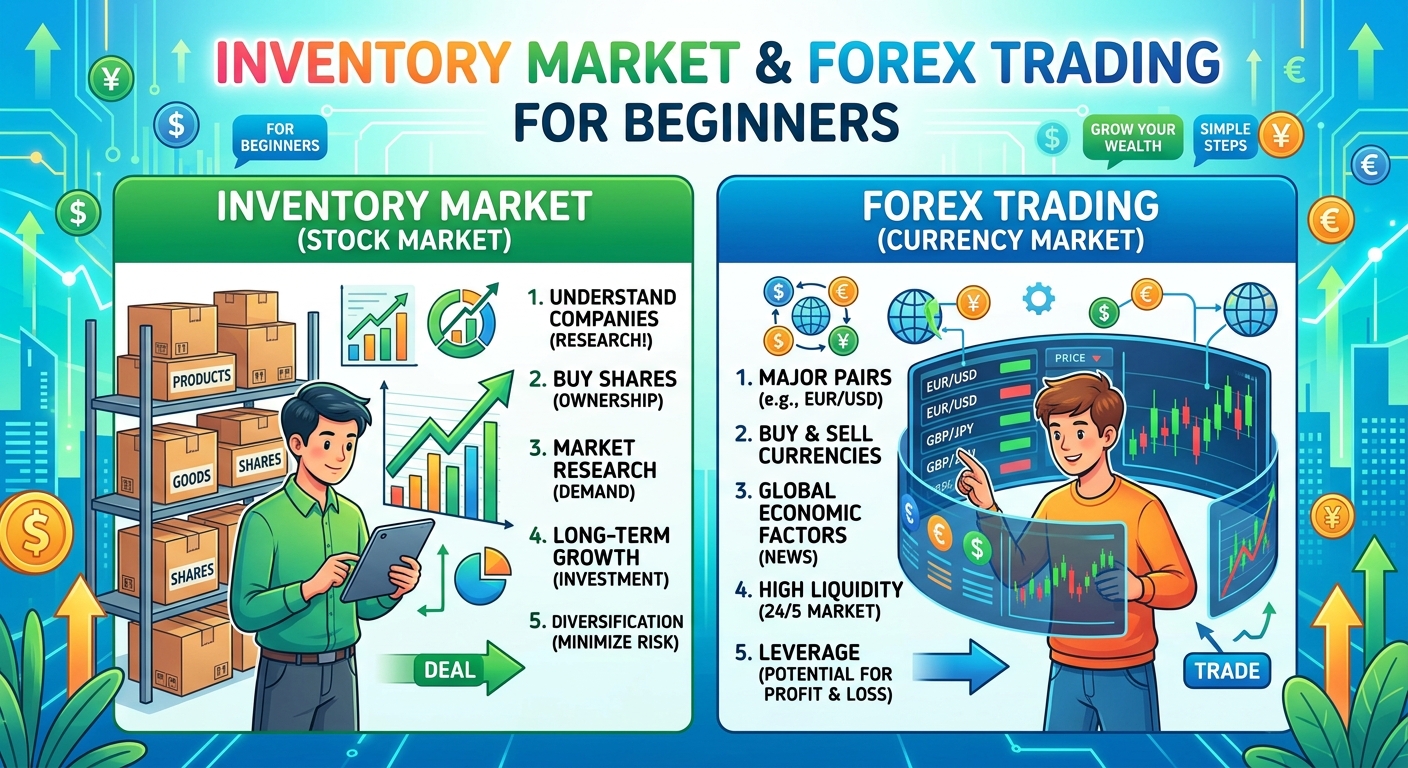
Inventory Market Buying and Selling and Forex Trading for Beginners

how to find new business opportunities