

Inventory Market: How Businesses Buy, Sell, and Manage Excess Stock
Inventory is one of the most consequential assets in a commercial operation. It represents products waiting to be sold, materials waiting to be transformed, or goods positioned strategically for future demand. Yet inventory can also become a liability when purchasing decisions, market conditions, or customer preferences move in an unexpected direction.
A retailer may order too many seasonal products. A manufacturer may produce more units than anticipated. An online seller may receive a large customer return shipment. A distributor may acquire merchandise that suddenly becomes difficult to sell.
What happens next?
The inventory still has value, but its original sales channel may no longer be appropriate.
This is where the modern inventory market becomes particularly interesting. Businesses can increasingly redirect excess merchandise through liquidation channels, secondary marketplaces, wholesale networks, auctions, resellers, and specialized platforms.
The objective is not merely to dispose of unwanted products.
It is to recover as much economic value as possible while reducing storage costs, freeing working capital, and keeping potentially useful goods within productive commercial circulation.
What Is an Inventory Market?
The term inventory market can describe a commercial environment in which businesses buy, sell, redistribute, or liquidate physical goods.
Unlike a conventional retail market, where products are generally sold directly to end consumers at established prices, inventory markets often involve transactions between businesses.
A manufacturer might sell excess production to a wholesaler.
A retailer might liquidate discontinued products.
A distributor might sell slow-moving stock to another merchant.
A liquidation company might acquire returned goods and resell them in bulk.
A reseller might purchase a mixed pallet of products and sell individual items through an online marketplace.
The inventory market is therefore a multifaceted ecosystem rather than a single centralized exchange.
Its participants have different motivations, but they share one underlying objective: turning available inventory into economic value.
Why Inventory Becomes Available
Inventory can enter secondary markets for many reasons.
Understanding those reasons is important because not all excess stock has the same condition, value, or risk profile.
Overstock
A business may simply have purchased more products than customers ultimately wanted.
Seasonal Merchandise
Products associated with holidays, weather, sporting events, or annual occasions can rapidly lose commercial relevance once the season ends.
Customer Returns
Returned merchandise may be perfectly functional, lightly used, damaged, incomplete, or impossible to resell as new.
Discontinued Products
Manufacturers and retailers regularly replace older models with newer versions.
Packaging Changes
A product may remain perfectly usable even though its packaging has been redesigned.
Business Closures
Companies leaving the market may liquidate substantial quantities of inventory.
Manufacturing Surplus
Factories sometimes produce more units than originally required.
Cancelled Orders
A large order can be cancelled after production or procurement has already taken place.
Minor Cosmetic Defects
Products with superficial imperfections may no longer qualify for conventional retail channels but can retain significant value elsewhere.
Each circumstance creates a different inventory opportunity.
Surplus Inventory: Asset or Liability?
Surplus inventory is stock exceeding the quantity a business reasonably expects to need for normal operations or anticipated demand.
At first glance, surplus sounds harmless.
After all, having extra products seems preferable to having none.
But excess stock can become expensive surprisingly quickly.
Consider a retailer holding 20,000 units of a product that sells slowly. Those units require:
- Warehouse space
- Handling
- Insurance
- Security
- Inventory tracking
- Capital
- Labor
- Potential financing
If the product is seasonal or technologically sensitive, its value may decline while it sits in storage.
A smartphone accessory may remain relevant for years.
A particular electronic device may become obsolete within months.
The longer inventory remains idle, the greater the possibility that its economic value deteriorates.
The Hidden Cost of Excess Inventory
The purchase price of inventory is only one component of its true cost.
Businesses should also consider carrying costs.
These can include storage rent, warehouse labor, insurance, deterioration, shrinkage, financing costs, and opportunity costs.
There is also a subtler cost: capital immobility.
Suppose a company has $500,000 tied up in slow-moving products.
That capital cannot easily be used to purchase faster-moving merchandise, expand operations, invest in technology, or strengthen cash reserves.
The inventory may still appear on the balance sheet as an asset.
Operationally, however, it may be obstructing the company’s ability to move.
This is why inventory optimization is closely connected to financial management.
Why Businesses Sell Excess Inventory
A company does not necessarily sell surplus products because the merchandise is worthless.
Quite the opposite.
A business may sell inventory at a discount because the alternative is economically worse.
Imagine a retailer purchased a product for $40 and expected to sell it for $70.
Demand collapses.
The company could keep the product for another year, continuing to pay storage costs and risking further depreciation.
Alternatively, it could sell the inventory in bulk to another business for $25.
The $15 loss compared with the original purchase price is unpleasant.
But recovering $25 today may be economically superior to spending another year carrying the product.
This is an important principle of inventory liquidation:
Recovering part of an asset’s value can be more rational than protecting an outdated valuation.
How an Overstock Marketplace Works
An overstock marketplace provides a channel through which excess, returned, discontinued, or otherwise surplus products can be offered to other buyers.
The marketplace may connect:
- Retailers
- Manufacturers
- Wholesalers
- Liquidators
- Resellers
- Small businesses
- Discount retailers
- E-commerce merchants
Transactions can occur in various formats.
Products may be sold individually, by case, by pallet, by lot, or by truckload.
The larger the quantity, the more important due diligence becomes.
A buyer acquiring five products can inspect each item.
A buyer acquiring 5,000 mixed units cannot realistically inspect every piece before purchasing.
This is where grading, manifests, product descriptions, photographs, seller reputation, and return policies become particularly important.
Types of Inventory Sold Through Secondary Markets
Inventory marketplaces can contain remarkably diverse products.
Common categories include:
Consumer Electronics
Phones, accessories, computers, peripherals, and household technology.
Apparel
Clothing, footwear, accessories, and seasonal fashion.
Home Goods
Furniture, kitchen equipment, décor, appliances, and household supplies.
Tools and Hardware
Hand tools, power tools, fittings, and construction-related products.
Beauty Products
Cosmetics, personal-care products, and salon supplies.
Toys
Children’s products, games, educational materials, and seasonal merchandise.
Industrial Goods
Components, machinery parts, equipment, and specialized materials.
The economics of each category differ.
Electronics may depreciate rapidly.
Furniture can be expensive to transport.
Apparel may become less desirable as fashions change.
Industrial components may have little value to ordinary consumers but considerable value to a specialized buyer.
Inventory Grading Matters
One of the most important concepts in secondary inventory markets is product condition.
Inventory should not be treated as a homogeneous commodity.
A marketplace may distinguish between:
- New
- New in original packaging
- Open-box
- Customer return
- Refurbished
- Used
- Damaged
- Salvage
- Untested
These classifications can dramatically affect expected resale value.
A pallet described as “new” is fundamentally different from one described as “customer returns.”
A buyer who ignores this distinction may calculate profitability using unrealistic assumptions.
Condition is therefore not a footnote.
It is part of the valuation.
The Importance of Inventory Manifests
A manifest is a document describing the contents of a lot, pallet, shipment, or other inventory grouping.
A detailed manifest might include:
- Product names
- Stock-keeping units
- Quantities
- Retail prices
- Product condition
- Estimated values
- Item descriptions
Manifests can help buyers estimate potential resale value.
However, a manifest should not automatically be interpreted as a guarantee of realized revenue.
There is a considerable difference between theoretical retail value and actual resale value.
A product might have a listed retail price of $100 but only command $45 in a competitive secondary market.
Sophisticated buyers therefore evaluate realistic liquidation value, not merely the advertised retail price.
Retail Value Versus Resale Value
This distinction is crucial.
Suppose a marketplace offers a lot containing products with a combined suggested retail value of $20,000.
That does not mean the buyer has acquired $20,000 worth of immediately realizable revenue.
The buyer must account for:
- Actual market demand
- Product condition
- Competition
- Marketplace fees
- Shipping
- Storage
- Returns
- Advertising
- Labor
- Taxes
- Unsold items
Perhaps the inventory can realistically generate $12,000 in gross sales.
If the acquisition cost is $7,000 and additional expenses total $3,000, the economic picture is very different from simply comparing $7,000 with a $20,000 retail figure.
Good inventory trading depends on realistic numbers.
Buying Inventory for Resale
Resellers often use secondary inventory markets as sourcing channels.
Instead of purchasing products from traditional wholesalers at standard wholesale prices, they may acquire excess stock at discounted rates.
The potential advantage is straightforward.
Lower acquisition costs can create additional margin.
But purchasing cheaply is not sufficient.
The real objective is to purchase profitably.
A $2 product that cannot be sold is not necessarily a better investment than a $10 product with strong demand.
The buyer must consider the entire resale equation.
A Simple Inventory Resale Formula
A basic profitability model can be expressed as:
Expected Sales Revenue − Acquisition Cost − Operating Costs = Estimated Profit
Operating costs may include:
- Transportation
- Warehousing
- Marketplace fees
- Payment processing
- Packaging
- Labor
- Advertising
- Returns
- Repairs
- Disposal
Suppose a reseller purchases a lot for $5,000.
They estimate:
- $8,000 in realistic sales
- $1,000 in transportation and handling
- $700 in marketplace and payment fees
- $500 in advertising and packaging
The estimated profit would be:
$8,000 − $5,000 − $1,000 − $700 − $500 = $800
That is very different from assuming an $3,000 profit simply because the expected sales revenue exceeds the acquisition price by $3,000.
Why Storage Capacity Matters
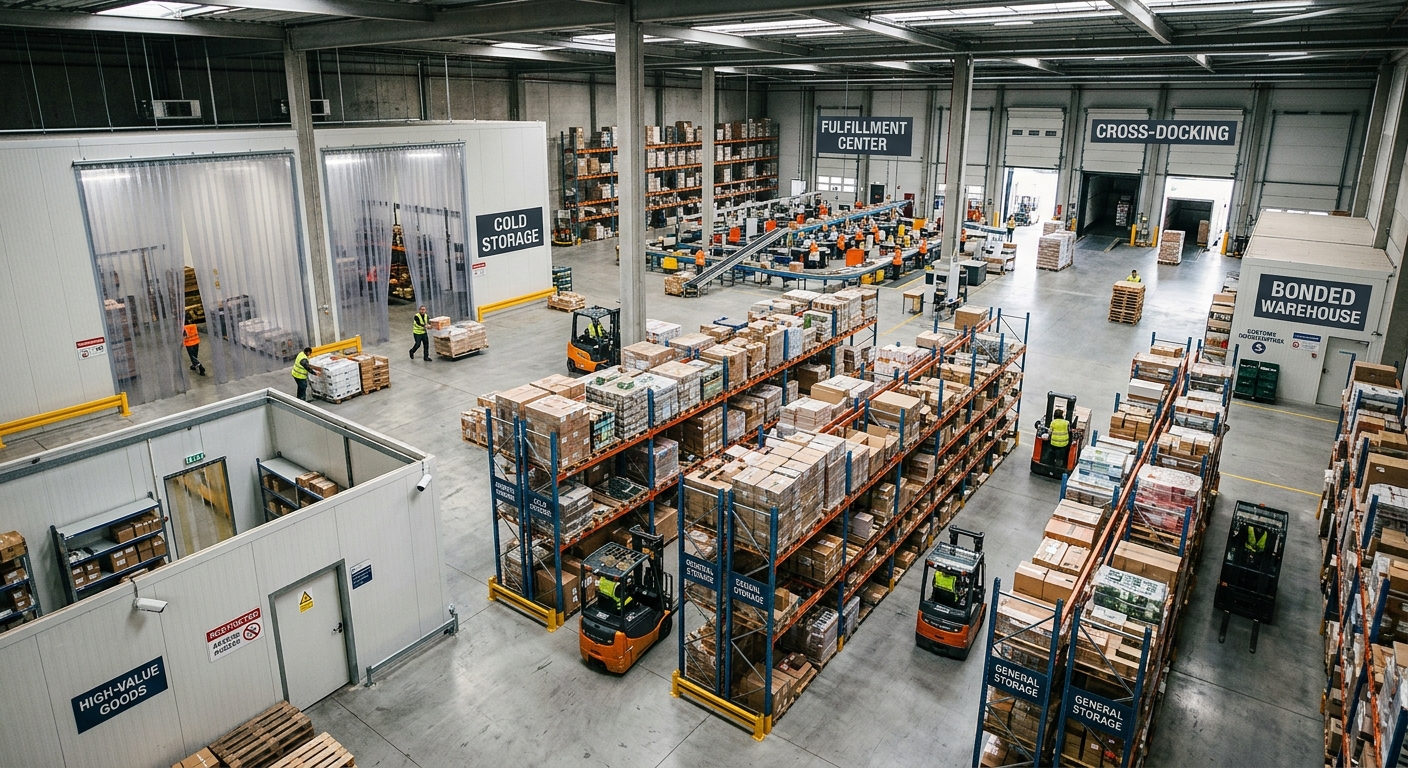
Buying inventory creates a physical obligation.
This is easy to underestimate when purchasing online.
A digital marketplace can make a 1,000-unit inventory lot appear almost abstract.
It is not abstract.
Those products occupy physical space.
They must be received, counted, organized, stored, picked, packed, and eventually shipped.
Before purchasing large quantities, buyers should consider:
- Available warehouse capacity
- Shelf requirements
- Product dimensions
- Weight
- Handling requirements
- Climate requirements
- Security
- Expected turnover
Cheap inventory that overwhelms warehouse capacity can quickly become operationally expensive.
Logistics and the Inventory Market
Transportation is another critical component.
A buyer purchasing one pallet may face a manageable freight cost.
A buyer purchasing several truckloads needs a much more sophisticated logistics plan.
Transportation expenses depend on:
- Distance
- Weight
- Volume
- Freight class
- Delivery location
- Fuel prices
- Carrier availability
- Loading requirements
The economics of a deal can change substantially once freight is included.
This is why experienced inventory buyers calculate landed cost rather than focusing exclusively on purchase price.
Landed cost represents the total expense required to get inventory into a usable selling position.
Inventory Liquidation
Liquidation is the process of converting unwanted or excess inventory into cash.
It can occur through:
- Bulk sales
- Auctions
- Discount retailers
- Wholesale buyers
- Online marketplaces
- Specialized liquidators
- Employee sales
- Clearance events
Liquidation is particularly useful when the primary sales channel is no longer economical.
The objective is often speed as much as price.
A company may willingly accept a lower unit price if doing so releases warehouse capacity and working capital quickly.
The Difference Between Clearance and Liquidation
Clearance and liquidation are related but not identical.
Clearance generally refers to reducing prices to accelerate sales through an existing retail channel.
Liquidation often involves a more substantial conversion of inventory into cash, sometimes through bulk transactions or specialized buyers.
A retailer might place discontinued clothing on a clearance rack.
A business liquidating an entire product line might sell several thousand units to a wholesale buyer.
The latter is closer to traditional inventory liquidation.
Returns as a Source of Secondary Inventory
E-commerce has dramatically increased the volume of returned merchandise entering secondary markets.
A returned product can fall into several categories.
It may be:
- Completely unused
- Opened but functional
- Lightly used
- Damaged
- Missing accessories
- Defective
- Difficult to test
For businesses capable of inspecting, repairing, refurbishing, and repackaging goods, returns can represent an interesting sourcing opportunity.
For inexperienced buyers, however, return pallets can contain considerable uncertainty.
The expected discount needs to compensate for that uncertainty.
The Economics of Uncertainty
Uncertainty itself has a price.
Suppose two inventory lots each cost $5,000.
Lot A contains verified new products with a detailed manifest.
Lot B contains untested customer returns with incomplete descriptions.
Even if both lots have the same estimated retail value, they should not necessarily command the same acquisition price.
Lot B carries additional risk:
- Unknown defects
- Missing parts
- Higher processing costs
- Greater return rates
- Lower resale prices
- Disposal expenses
A rational buyer should demand a sufficient margin to compensate for these uncertainties.
Technology in Inventory Marketplaces
Digital platforms have made inventory trading considerably more accessible.
Modern systems can facilitate:
- Product discovery
- Lot comparison
- Digital manifests
- Auctions
- Automated bidding
- Seller ratings
- Payment processing
- Shipping coordination
- Inventory tracking
This has helped transform what was once a fragmented liquidation process into a more visible commercial ecosystem.
However, technology does not eliminate due diligence.
A sophisticated interface cannot make an unprofitable inventory lot profitable.
Data-Driven Inventory Decisions
Data can help businesses determine when inventory should be retained, discounted, transferred, or liquidated.
Useful metrics include:
Sell-Through Rate
What percentage of inventory sells within a given period?
Days on Hand
How long is current stock expected to last?
Gross Margin
How much revenue remains after the direct cost of goods?
Carrying Cost
What does it cost to keep inventory?
Inventory Aging
How long has each product remained unsold?
Return Rate
How frequently are products returned?
Contribution Margin
How much does each unit contribute toward covering operating expenses and profit?
These metrics help replace vague intuition with measurable evidence.
Inventory Aging
Inventory aging categorizes stock according to how long it has remained unsold.
For example:
- 0–30 days
- 31–60 days
- 61–90 days
- 91–180 days
- 180+ days
The appropriate thresholds depend on the industry.
A 180-day-old industrial component may be perfectly normal.
A 180-day-old fashion item could already be commercially obsolete.
Aging reports can help identify inventory that deserves intervention.
The earlier a problem is detected, the more options remain available.
What Happens When Inventory Is Ignored?
Excess inventory can create a domino effect.
First, warehouse space becomes constrained.
Then products become harder to organize.
Employees spend more time locating goods.
New inventory may be stored inefficiently.
Picking productivity can decline.
Carrying costs increase.
Eventually, the company may need deep discounts to clear the accumulated stock.
What began as a purchasing mistake becomes a logistics problem, then a financial problem, and finally a strategic problem.
Inventory management is therefore preventative as much as corrective.
How Businesses Can Reduce Excess Inventory
Several approaches can help.
Improve Forecasting
Use historical sales and current market signals to improve purchasing decisions.
Reduce Minimum Order Quantities
Where possible, negotiate more flexible purchasing arrangements.
Shorten Supplier Lead Times
Faster replenishment can reduce the need for large safety buffers.
Improve Product Segmentation
Not every SKU requires the same inventory policy.
Monitor Aging
Identify slow-moving products before they become dead stock.
Redistribute Inventory
Move products to locations where demand is stronger.
Use Secondary Markets
Sell excess stock before it becomes completely obsolete.
Establish Liquidation Thresholds
Create predefined criteria for when inventory should be discounted or sold in bulk.
The Strategic Role of the Overstock Marketplace
An overstock marketplace can therefore serve as more than a place to find cheap products.
It can function as a pressure-release mechanism within the broader supply chain.
For sellers, it creates an alternative channel for stock that has become difficult to sell through conventional retail.
For buyers, it provides access to products at potentially attractive acquisition prices.
For the wider economy, secondary markets can help reduce waste by extending the commercial life of products.
The marketplace effectively reconnects supply with a different form of demand.
That is its central economic function.
Sustainability and Secondary Inventory
The inventory market also has an environmental dimension.
When unsold products are discarded unnecessarily, the resources used to manufacture, package, and transport those goods are effectively wasted.
Secondary sales can extend product lifecycles.
A discontinued product may still be useful to another customer.
A returned appliance may be refurbished.
Excess clothing can move through discount channels.
Industrial components can find buyers in specialized markets.
This does not make secondary markets inherently sustainable—transportation, packaging, refurbishment, and disposal still have environmental impacts—but keeping usable products in circulation can reduce unnecessary waste.
Risks for Buyers
Inventory markets can provide attractive opportunities, but they also contain risks.
Buyers should investigate:
- Seller reputation
- Product condition
- Manifest accuracy
- Minimum purchase quantities
- Freight costs
- Return policies
- Product authenticity
- Regulatory requirements
- Warranty status
- Storage requirements
Some products may also require special certifications or handling procedures.
A deal that appears profitable on a spreadsheet may become problematic when regulatory or logistical requirements are considered.
Due diligence is therefore indispensable.
Risks for Sellers
Sellers face their own challenges.
Selling excess inventory too cheaply can destroy recoverable value.
Selling too slowly can increase carrying costs.
Providing inadequate product descriptions can create disputes.
Poor grading can damage buyer relationships.
For larger organizations, there is also a strategic consideration: excessive liquidation through public channels can sometimes influence perceptions of a brand.
The best liquidation strategy therefore balances recovery value, speed, confidentiality, and brand considerations.
The Future of the Inventory Market
The inventory market is becoming increasingly sophisticated.
Artificial intelligence can improve demand forecasting.
Automated warehouses can reduce handling costs.
Digital marketplaces can improve price discovery.
Data analytics can identify slow-moving products earlier.
Computer vision can assist with product inspection and grading.
Predictive systems may eventually determine the optimal moment to redirect inventory from a primary sales channel to a secondary one.
Instead of waiting until products become obsolete, businesses can intervene while meaningful resale value remains.
That shift—from reactive liquidation to predictive inventory optimization—could be one of the most important developments in modern commerce.
Conclusion
The inventory market exists because supply and demand rarely align perfectly.
Businesses will inevitably purchase too much, produce too much, receive unexpected returns, discontinue products, or misjudge consumer preferences. The existence of excess stock is not necessarily a sign of commercial incompetence. What matters is how intelligently that stock is managed once reality diverges from the original plan.
Surplus inventory should therefore not automatically be viewed as worthless merchandise.
It can represent recoverable capital.
Through wholesale transactions, liquidation, resale, auctions, redistribution, and an overstock marketplace, businesses can often find new routes for products that no longer fit their original sales strategy.
For buyers, these markets can provide access to discounted merchandise and potentially attractive resale opportunities. But the discount must be evaluated against product condition, demand, logistics, storage, marketplace fees, and the uncertainty inherent in secondary inventory.
For sellers, the challenge is equally nuanced. Holding excess stock for too long can consume capital and warehouse capacity, while liquidating too quickly can sacrifice recoverable value.
The most effective approach lies somewhere between those extremes.
Inventory should be monitored continuously. Aging should be measured. Demand should be forecast. Slow-moving products should be identified early. And when conventional sales channels stop producing satisfactory results, alternative markets should be considered before inventory becomes obsolete.
Ultimately, the modern inventory market performs a valuable economic function: it gives products a second commercial pathway.
Goods do not necessarily lose their usefulness simply because one retailer, distributor, or manufacturer no longer needs them.
They may simply need a different buyer.


You May Also Like

physical security of businesses and how to keep your staff safe and secure
Trading Economics: Understanding the Forces That Drive Global Markets