The Gig Economy Hits Delivery Drivers in Their Wallets
The gig economy has transformed the way goods move through cities.
A customer taps a smartphone screen. A restaurant receives an order. A driver accepts a delivery. Within minutes, a decentralized chain of software, vehicles, warehouses, restaurants, and independent workers begins moving a product toward its final destination.
The process looks seamless.
For delivery drivers, however, the economics can be considerably less straightforward.
Behind the convenience of rapid delivery lies a complicated calculation involving fuel, vehicle maintenance, insurance, commissions, platform fees, unpaid waiting time, traffic congestion, and fluctuating demand. A driver may complete dozens of deliveries during a busy day and still discover that the amount remaining after expenses is far lower than the gross income displayed by an application.
This is one of the central contradictions of the modern gig economy: convenience for the customer does not necessarily translate into financial security for the worker.
The issue is particularly significant in densely populated Asian cities, where motorcycles and scooters have become indispensable components of last-mile delivery.
What Is the Gig Economy?
The gig economy refers to a labor market in which people earn income through short-term, task-based, freelance, or platform-mediated work rather than traditional permanent employment.
Delivery driving has become one of its most visible forms.
Digital platforms can connect customers, restaurants, retailers, and drivers almost instantaneously. The platform determines or influences many aspects of the transaction, including delivery assignments, pricing, navigation, customer communication, and payment.
This model offers flexibility.
Drivers can often decide when to work and may be able to use several platforms.
But flexibility has another side.
The worker may also absorb many of the costs traditionally associated with operating a business.
The Difference Between Gross and Net Income
One of the most important concepts in understanding delivery-driver economics is the distinction between gross and net earnings.
Suppose a driver earns the equivalent of $50 during a day’s work.
That figure may initially look attractive.
But the driver may also have to pay for:
- Fuel
- Motorcycle maintenance
- Tires
- Engine oil
- Repairs
- Mobile data
- Insurance
- Vehicle depreciation
- Parking
- Food and water
- Financing or rental costs
The actual amount available after these expenses can be substantially lower.
This distinction is frequently overlooked when gig-economy income is discussed.
Gross earnings tell only part of the story.
Net earnings reveal the economic reality.
Fuel Is a Direct Hit to Earnings
Fuel is among the most obvious operating costs for delivery drivers.
Every additional kilometer has a price.
In cities where drivers travel continuously throughout the day, fuel consumption can become a substantial portion of their operating expenses.
Traffic makes the situation more complicated.
A motorcycle stuck in congestion may travel only a short distance while continuing to consume fuel and working time.
This creates a peculiar economic equation:
More time on the road does not necessarily mean more income.
If drivers spend too much time traveling without receiving sufficiently compensated orders, their effective hourly earnings can decline.
Vehicle Maintenance Is the Invisible Expense
Fuel is easy to notice.
Vehicle depreciation is not.
Every kilometer contributes to wear.
Motorcycles require:
- Oil changes
- Brake maintenance
- Tire replacement
- Chain maintenance
- Battery replacement
- Repairs
- Periodic servicing
The cost accumulates gradually.
A driver who ignores maintenance may temporarily reduce expenses but eventually face a larger repair bill.
A broken motorcycle can be particularly damaging because it eliminates the driver’s ability to earn income while simultaneously generating an expense.
The vehicle is not merely transportation.
It is the driver’s productive asset.
Depreciation Matters Too
A motorcycle becomes less valuable as it accumulates mileage and age.
This depreciation is an economic cost even though no money leaves the driver’s pocket on a particular day.
Consider a driver who purchases a motorcycle primarily to perform deliveries.
The vehicle experiences substantially more use than a motorcycle used only for commuting.
Its resale value may decline faster.
Therefore, part of every delivery payment is effectively compensating for the gradual consumption of the vehicle itself.
Ignoring depreciation can make gig work appear more profitable than it actually is.
Waiting Time Is Often Unpaid
One of the most overlooked elements of delivery work is waiting.
A driver may arrive at a restaurant and wait for the food to be prepared.
Or a customer may take several minutes to reach the delivery point.
The application may show the driver as working, but the payment structure may not fully compensate for this time.
This matters because delivery work is not simply about distance.
It is about time.
A delivery that takes fifteen minutes in theory may consume thirty or forty minutes in practice.
The effective hourly income therefore depends on the entire delivery cycle.
Traffic Changes the Economics
Traffic congestion can transform a profitable route into an inefficient one.
This is particularly important in major Asian metropolitan areas.
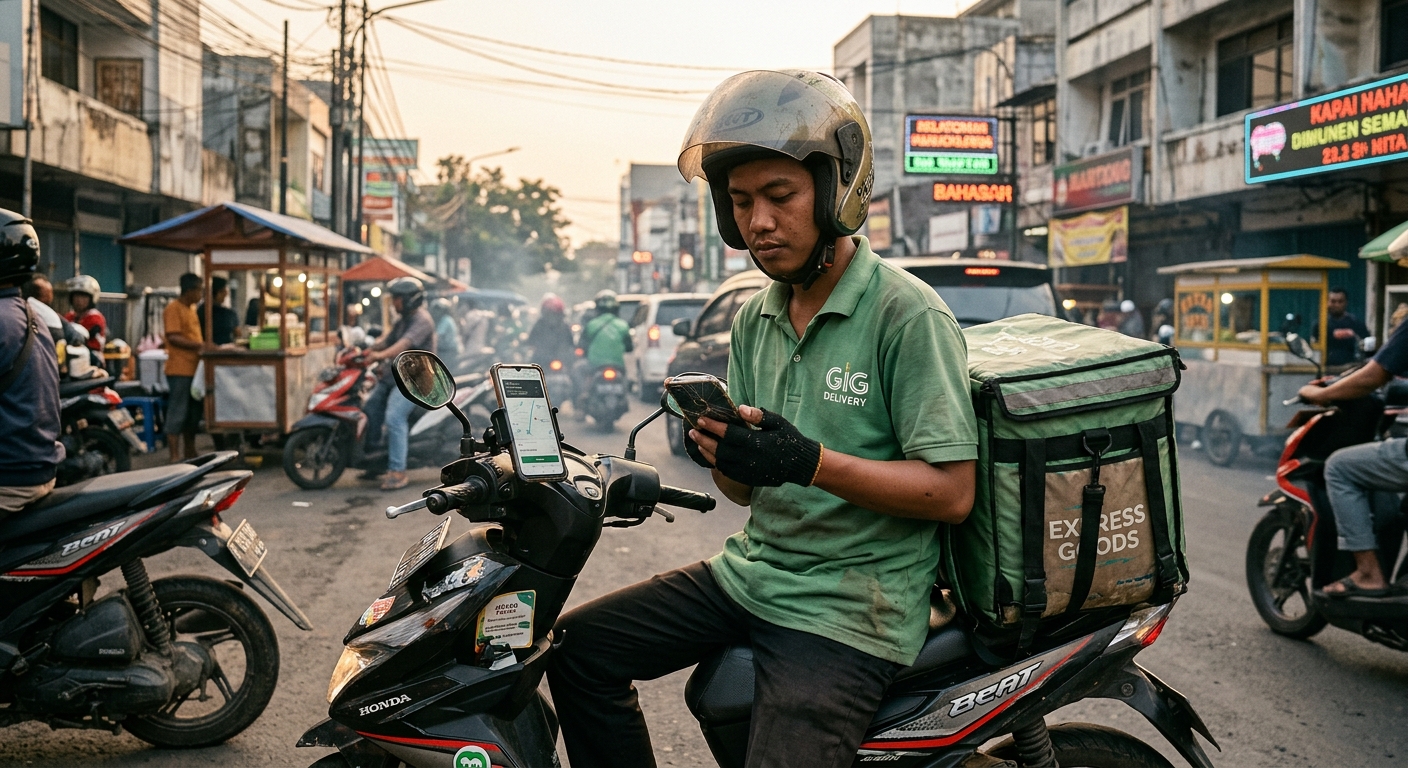
In Jakarta Asia, for example, dense traffic and intense urban activity make last-mile logistics especially dependent on motorcycles and other agile transport options.
A route that appears short on a digital map may take considerably longer during peak periods.
The driver bears the consequences.
More time means fewer opportunities to accept additional orders.
This is a classic last-mile logistics problem: geographic distance is only one measure of difficulty.
Why Last-Mile Delivery Is So Difficult
The final stage of a delivery is often the most complicated.
A shipment may travel hundreds or thousands of kilometers through organized logistics networks before reaching a city.
Then the final few kilometers can involve:
- Congestion
- Narrow roads
- Parking difficulties
- Building access
- Security checkpoints
- Incorrect addresses
- Customer availability
- Weather disruptions
This is why last-mile delivery is often one of the most expensive and operationally challenging components of logistics.
Drivers operate at the sharp end of this complexity.
Algorithmic Management
Gig-economy platforms rely heavily on algorithms.
Software may determine which driver receives an order, how routes are calculated, and how pricing changes according to demand.
This creates a form of algorithmic management.
The worker does not necessarily negotiate directly with a human manager.
Instead, the application becomes the interface through which work is allocated and evaluated.
This can increase efficiency.
But it can also make the economics opaque.
Drivers may understand how much they earned without fully understanding why certain orders were offered, rejected, or prioritized.
Dynamic Pricing and Demand
Delivery platforms frequently experience significant variations in demand.
Lunch hours can be busy.
Evenings may be particularly active.
Weekends can generate different patterns.
Bad weather may increase delivery demand while simultaneously making transportation more difficult.
Platforms can respond using dynamic pricing or incentives.
The basic principle is straightforward: when demand rises, platforms have an incentive to attract more drivers.
But incentives can change quickly.
A driver who plans a working schedule around a particular bonus may find that the requirements or availability of that incentive have changed.
Income can therefore become difficult to predict.
Flexibility Comes With Volatility
One of the strongest attractions of gig work is flexibility.
Drivers can often choose when to work.
This can be valuable for people with other responsibilities or income sources.
However, flexibility is not synonymous with stability.
Traditional employees may receive predictable wages for scheduled hours.
Gig workers may experience substantial variation from one day to another.
One evening can be exceptionally profitable.
The next can be slow.
This volatility complicates personal financial planning.
The Cost of Being Flexible
Flexibility also shifts some risk from the platform to the worker.
If demand falls, the driver may earn less.
If the motorcycle breaks down, the driver may be unable to work.
If fuel prices rise, operating costs increase.
If an accident occurs, the financial consequences can be substantial.
The worker effectively becomes a small independent logistics operator.
That status provides autonomy but also transfers responsibility.
Competition Between Drivers
Platforms can attract large numbers of drivers because entry barriers are often relatively low.
More drivers can improve customer service by increasing delivery capacity.
But additional supply can also reduce the number of orders available to each driver.
This creates a competitive environment.
When many drivers are waiting for the same pool of deliveries, individual utilization declines.
A driver can therefore spend significant time online without generating proportionally higher income.
The Importance of Utilization
In logistics, utilization refers to how effectively available capacity is being used.
For a delivery driver, an ideal day might involve a continuous sequence of reasonably compensated orders with minimal empty travel and waiting.
Reality is messier.
A driver may:
- Travel to a restaurant.
- Wait for an order.
- Deliver it.
- Travel back toward a busy area.
- Wait for another order.
Only part of this cycle may generate direct compensation.
Improving utilization is therefore critical to earnings.
Deadhead Miles
One particularly important concept is deadhead mileage.
This refers to travel without a paying passenger or cargo assignment.
For delivery drivers, it can occur when returning from a distant delivery or traveling toward an area where demand is expected.
The driver pays for the fuel and vehicle wear.
Yet no revenue is generated during that movement.
Reducing deadhead mileage can therefore have a substantial effect on net income.
Weather Adds Another Layer of Risk
Weather can dramatically change delivery conditions.
Heavy rain can reduce visibility.
Flooding can make roads impassable.
Extreme heat can increase physical strain.
Strong winds can create additional hazards for motorcycle riders.
At the same time, bad weather may increase demand for delivery services because customers prefer to remain indoors.
This creates an uncomfortable asymmetry.
Demand may increase precisely when working conditions become more difficult.
Safety Has an Economic Dimension
Road safety is not simply a personal concern.
It also has economic consequences.
An accident can result in:
- Medical expenses
- Vehicle repairs
- Lost working days
- Lost income
- Insurance claims
- Long-term financial difficulties
Pressure to complete more deliveries can potentially encourage risky behavior if workers feel that speed directly affects earnings.
This creates a structural challenge.
A logistics system should reward productivity without creating incentives for unsafe conduct.
Social Protection and Gig Workers
Traditional employment relationships often provide mechanisms such as:
- Paid leave
- Employer-sponsored insurance
- Retirement contributions
- Worker protections
- Predictable wages
Gig workers may have access to fewer protections, depending on the jurisdiction and contractual arrangement.
This creates an important policy question:
Who should bear the cost of employment-related risk in a platform economy?
There is no universal answer.
Different countries are experimenting with different approaches to worker classification, benefits, insurance, and platform responsibility.
The Consumer’s Role
Consumers are part of this system too.
Customers often expect delivery to be:
- Fast
- Cheap
- Convenient
- Trackable
- Reliable
Providing all five simultaneously is difficult.
Extremely low delivery prices can place pressure on the economics of the service.
Consumers may therefore benefit from considering the true cost of convenience.
A delivery that costs very little may appear efficient from the customer’s perspective while leaving limited economic value for the person performing the physical work.
Technology Can Improve Efficiency
Technology is not necessarily the enemy of drivers.
Better technology can reduce wasted time.
Route optimization can reduce unnecessary mileage.
Predictive demand systems can position drivers closer to areas with expected orders.
Accurate mapping can reduce navigation errors.
Digital payments eliminate certain administrative burdens.
Real-time traffic information can help drivers avoid congestion.
The challenge is ensuring that efficiency gains are distributed fairly.
If technology reduces the time required to complete a delivery, the benefits should not automatically accrue exclusively to the platform or customer.
Toward a More Sustainable Delivery Model
A sustainable gig-delivery ecosystem needs to consider the economics of every participant.
For platforms, sustainability means maintaining reliable service and sufficient driver availability.
For customers, it means reasonable prices and dependable deliveries.
For businesses, it means viable distribution costs.
For drivers, it means compensation that remains meaningful after operating expenses.
These interests are interconnected.
If driver earnings become persistently unattractive, experienced drivers may leave.
That can reduce service quality.
Customers experience longer waiting times.
Platforms face higher recruitment costs.
The entire system becomes less stable.
What Could Improve Driver Economics?
Several approaches could potentially improve the financial sustainability of delivery work.
Greater Payment Transparency
Drivers should be able to understand how payments are calculated.
Better Compensation for Waiting
Time spent performing required delivery activities should be recognized appropriately.
Distance-Based Cost Consideration
Payment structures can account for fuel and vehicle operating costs.
Improved Route Optimization
Reducing unnecessary mileage can increase effective earnings.
Insurance and Safety Programs
Appropriate protections can reduce the financial consequences of accidents.
Predictable Incentive Structures
Clearer bonus systems can make income easier to plan.
Access to Financial Tools
Savings, insurance, and affordable maintenance financing can help workers manage income volatility.
The Future of Delivery Work
The delivery economy is likely to become increasingly technological.
Artificial intelligence will influence demand forecasting.
Navigation systems will become more sophisticated.
Electric motorcycles may reduce fuel and maintenance costs.
Automated warehouses may accelerate order preparation.
Drones and autonomous delivery systems may eventually handle certain routes.
Yet technology will not eliminate the underlying economic question.
Who pays for convenience?
A customer wants rapid delivery.
A restaurant wants affordable logistics.
A platform wants efficient operations.
A driver wants compensation that covers both time and costs.
The system must find an equilibrium among these competing interests.
Conclusion
The gig economy has made delivery remarkably convenient.
With a few taps, customers can order meals, groceries, documents, packages, and countless other goods. Businesses can reach customers without maintaining their own extensive delivery fleets. Platforms can coordinate enormous networks of workers and orders through software.
But the apparent simplicity of the customer experience conceals a complicated economic reality.
For drivers, earnings are affected by fuel, depreciation, maintenance, waiting time, traffic, deadhead mileage, demand fluctuations, safety risks, and platform incentives. Gross income can therefore provide an incomplete picture of financial well-being.
The central issue is not whether gig delivery is inherently good or bad.
It is whether the economics of the system are sustainable.
A delivery network depends on people willing to perform the final and often most difficult stage of the journey. If the financial equation consistently works against those workers, the convenience enjoyed by customers may become increasingly difficult to sustain.
The future of the gig economy will therefore depend on more than faster algorithms and cheaper deliveries.
It will depend on creating a system in which efficiency, convenience, and worker economics can coexist.
Because behind every delivery notification is a person navigating the real world—and every kilometer has a cost.