Manhattan Faces a Reckoning if Working From Home Becomes the Norm
Manhattan has long depended on a deceptively simple proposition: people come to the island to work, and their presence generates an enormous ecosystem around them.
They commute into offices. They buy breakfast on the way to work. They meet colleagues for lunch. They stop for coffee in the afternoon. They visit shops after leaving the office. They occupy apartments, hail taxis, use public transportation, attend restaurants, visit cultural institutions, and spend money in countless businesses that depend, directly or indirectly, on the daily rhythm of office life.
But what happens when that rhythm changes permanently?
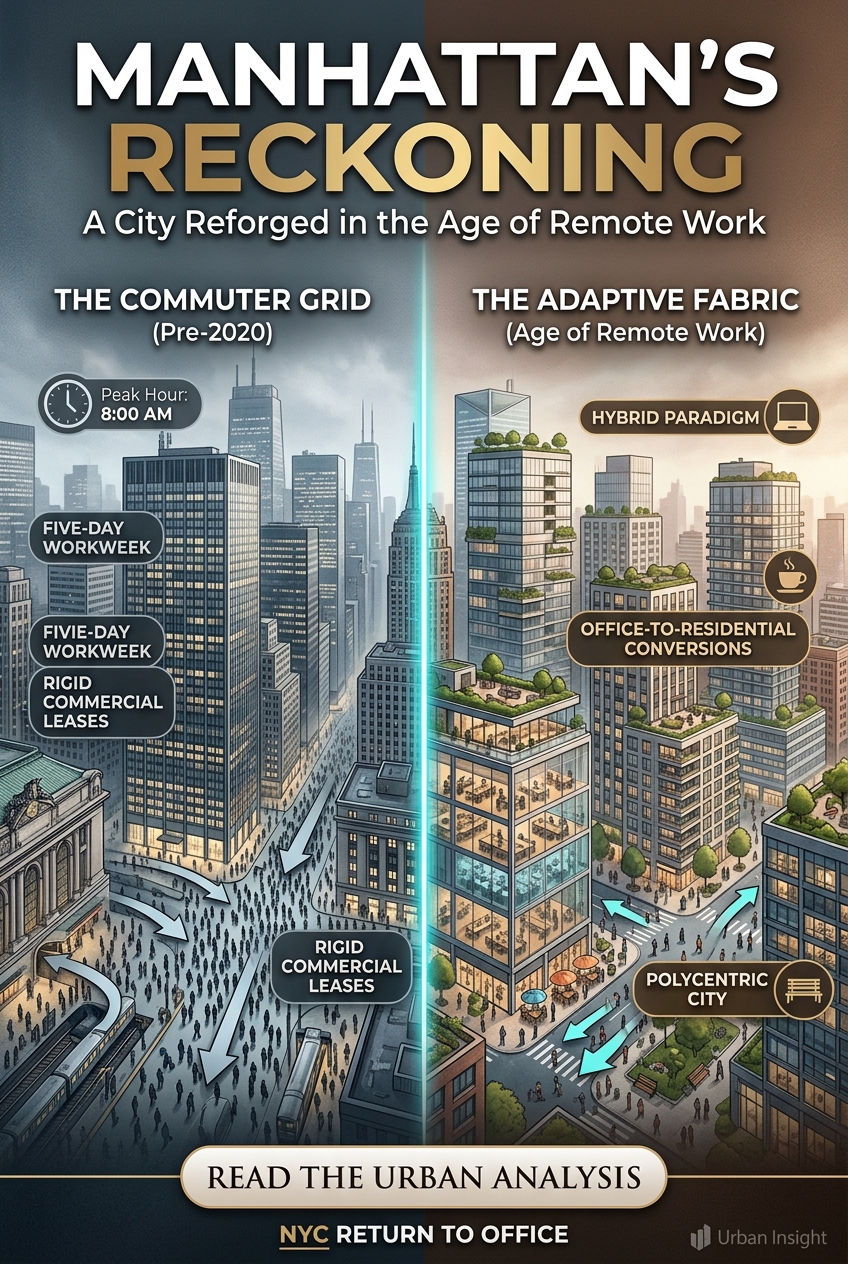
If working from home—or a hybrid model in which employees spend only part of the week in the office—becomes the norm, Manhattan could face a profound economic and urban transformation. The issue is not simply whether office towers remain occupied. The deeper question is whether the economic choreography surrounding those towers can survive when millions of workers no longer arrive five days a week.
The consequences could reach far beyond commercial real estate.
Restaurants, retailers, transportation networks, residential neighborhoods, tax revenues, public spaces, and even the cultural identity of Midtown and Lower Manhattan could be affected. A city built around concentration may need to adapt to dispersion.
And Manhattan has never been particularly timid about transformation.
Manhattan’s Office Economy Is More Than Office Space
The conventional understanding of Manhattan’s commercial economy often centers on skyscrapers.
That is only part of the story.
An office worker represents an entire chain of economic activity. The employee who purchases a coffee in the morning supports a café employee. The office lunch supports a restaurant. The evening drink supports a bar. The commuter’s subway fare contributes to the transportation system. A dry cleaner near the office may depend on professionals dropping off shirts during lunch.
The office therefore functions as an economic magnet.
Its gravitational pull extends well beyond the building itself.
When thousands of workers occupy a neighborhood simultaneously, their collective consumption creates density that businesses can monetize. This density is one of Manhattan’s great competitive advantages.
But remote work changes the equation.
If an employee works from a suburban home three days a week, that person’s economic activity has not disappeared. It has moved.
The morning coffee might now come from a local café. Lunch may be purchased near the employee’s home. The commuter rail journey may become less frequent. The Manhattan restaurant loses a customer, while a neighborhood establishment elsewhere gains one.
Repeated across hundreds of thousands of workers, this migration of spending could become economically consequential.
The Manhattan Reckoning Is Already About More Than Remote Work
It would be simplistic to argue that working from home alone will determine Manhattan’s future.
Urban economies are influenced by interest rates, tourism, immigration, housing costs, demographic changes, corporate restructuring, retail trends, and broader technological shifts.
Nevertheless, remote and hybrid work can accelerate existing pressures.
Office buildings designed around maximum occupancy may no longer generate the same level of pedestrian traffic. Businesses that were viable when workers appeared every weekday may struggle when Tuesday and Thursday are bustling but Monday and Friday feel comparatively subdued.
That creates a peculiar phenomenon.
The office may still be occupied, but the surrounding ecosystem is less consistently populated.
This distinction matters.
A restaurant cannot easily compensate for losing a large number of weekday customers simply because its tables are full on two evenings. A retailer near an office district cannot necessarily replace thousands of daily transactions with occasional weekend shoppers.
Density has a rhythm.
Remote work disrupts it.
What Happens to Manhattan’s Restaurants?
Few businesses embody Manhattan’s dependence on office workers more clearly than restaurants.
Consider the midday economy.
A financial district restaurant may have been designed around breakfast meetings, business lunches, afternoon coffee, and post-work drinks. If a substantial percentage of nearby employees work remotely on Mondays and Fridays, those revenue streams can become markedly less predictable.
Some restaurants will adapt.
Others may not.
The transformation could favor establishments with strong residential, tourist, or experiential appeal. Restaurants that give people a reason to travel specifically for the experience may prove more resilient than establishments whose principal advantage was simply proximity to an office.
And then there is the curious case of the cocktail.
A classic manhattan drink has little to do with Manhattan’s office economy, yet the coincidence is almost too perfect. The cocktail is traditionally associated with whiskey, sweet vermouth, and bitters, often served with a cherry. It is an emblem of the polished urban drinking culture for which New York is famous.
A traditional manhattan recipe is typically built around whiskey, sweet vermouth, and aromatic bitters, although proportions and garnishes vary.
The drink illustrates something important about Manhattan’s identity: its culture has always been intertwined with places where people gather after work.
Bars are not merely places to consume beverages. They are social infrastructure.
If fewer workers remain downtown late into the afternoon, that infrastructure will have to evolve.
The Residential Manhattan Question
Remote work creates another intriguing possibility: Manhattan could become more residential.
At first glance, that sounds like a contradiction.
For decades, enormous portions of Lower Manhattan and Midtown have been characterized by commercial uses. If office demand declines structurally, however, pressure may increase to convert underused commercial buildings into housing.
This would not be simple.
Office towers were not necessarily designed to become apartments. Floor plates, plumbing systems, elevators, natural-light requirements, zoning regulations, building codes, and mechanical infrastructure can make conversion technically difficult and financially expensive.
Yet the underlying idea has considerable appeal.
Instead of allowing office districts to become partially dormant after business hours, Manhattan could create neighborhoods where people live, work, shop, dine, and socialize throughout the day.
That would represent a profound shift in urban morphology.
The city would become less dependent on the traditional commuter model.
Could Remote Work Actually Make Manhattan More Livable?
There is an intriguing paradox here.
The decline of office attendance could weaken Manhattan’s traditional economic model while simultaneously making certain aspects of urban life more attractive.
Fewer daily commuters could mean less pressure on transportation infrastructure during peak periods.
More residential development could create stronger neighborhood communities.
Office-to-residential conversions could increase housing supply, although the extent would depend heavily on economics and regulation.
Retail districts could evolve toward entertainment, hospitality, culture, and services rather than relying primarily on weekday office traffic.
The city might become less of a place where people arrive to work and more of a place where people choose to live.
That would not necessarily be a decline.
It would be a metamorphosis.
The challenge is managing the transition without allowing commercial vacancies, falling property values, or declining municipal revenues to create a vicious cycle.
The Transportation System Faces Its Own Challenge
Manhattan’s transportation network was built around enormous volumes of commuters.
Every morning, millions of people have historically converged on employment centers. Every afternoon and evening, many of them reverse direction.
Remote work interrupts this choreography.
Lower commuter volumes can reduce congestion during peak periods, but they can also create financial challenges for transportation systems that rely on substantial passenger volume.
There is also a broader spatial question.
If workers travel less frequently into Manhattan, businesses outside the island may gain new opportunities. Suburban and residential neighborhoods can develop stronger commercial ecosystems because people are spending more of their working week closer to home.
The metropolitan region could therefore become more polycentric.
Instead of one overwhelmingly dominant employment center, economic activity may become distributed among numerous smaller hubs.
For Manhattan, that would represent a significant diminution of its traditional gravitational dominance.
Midtown Faces a Particularly Difficult Question
Midtown Manhattan contains some of the most recognizable commercial real estate on Earth.
But prestige alone does not guarantee demand.
Older buildings may face greater pressure if tenants increasingly prefer modern properties with better amenities, efficient floor plans, advanced environmental systems, and attractive communal spaces.
This could create a bifurcated market.
The most desirable buildings may remain highly competitive, while obsolete or poorly configured properties struggle.
In that environment, landlords may have to invest heavily in modernization.
Office buildings could acquire gyms, restaurants, lounges, outdoor spaces, wellness facilities, childcare services, collaboration areas, and other amenities intended to make physical attendance more appealing.
The office may become less of a mandatory workplace and more of a destination.
That is an important distinction.
If employees can perform individual tasks from home, the office must offer something that remote environments cannot easily reproduce.
Human interaction is one obvious answer.
The Value of Serendipity
One of the strongest arguments for maintaining physical workplaces is not technological but social.
Ideas often emerge from unplanned interactions.
A conversation in an elevator can lead to a new project. A chance meeting at lunch can introduce two employees who later collaborate. A spontaneous discussion after a presentation can produce an insight that would never have appeared in a scheduled video conference.
These interactions are difficult to quantify.
They are also difficult to manufacture.
Manhattan’s density historically created extraordinary opportunities for this kind of serendipity. Thousands of professionals from different industries occupy the same geographic ecosystem.
If workers become permanently dispersed, some of that cross-pollination could diminish.
The counterargument is equally compelling: remote communication technologies can maintain professional relationships while giving employees greater autonomy and reducing commuting burdens.
The future will likely involve an uneasy equilibrium between these two realities.
A New Meaning of the Manhattan Lifestyle
The concept of “working in Manhattan” has traditionally implied a daily physical routine.
Wake up.
Commute.
Work.
Eat lunch.
Work again.
Meet friends.
Have dinner or a drink.
Return home.
Remote work breaks the sequence into fragments.
A person might work in Brooklyn on Monday, Manhattan on Tuesday, from home on Wednesday, and visit a coworking space on Thursday.
That fragmentation could reshape the meaning of proximity.
Why live near the office if you only visit it twice a week?
Why pay Manhattan prices if professional life can be conducted from almost anywhere?
Those questions could place pressure on residential real estate, particularly if large numbers of workers reassess the premium they pay for proximity to traditional employment centers.
At the same time, Manhattan offers qualities that remote work cannot replicate easily: culture, restaurants, architecture, entertainment, networking, walkability, and extraordinary concentrations of institutions.
The island’s future may therefore depend on selling Manhattan as a place to experience, not merely a place to work.
The Hospitality Industry May Need to Change
Hotels and hospitality businesses also depend on Manhattan’s concentration of commercial and cultural activity.
Business travel has historically represented a substantial source of demand. Conferences, meetings, corporate events, and professional travel can fill hotels during weekdays.
If companies permanently reduce business travel and office attendance, hotels may need to rely more heavily on leisure visitors.
That could encourage a shift toward experiential hospitality.
Rather than simply providing accommodation, hotels may emphasize restaurants, rooftop spaces, cultural programming, wellness services, and local experiences.
The city itself becomes part of the product.
What Could Save Manhattan’s Commercial Districts?
Adaptability.
The most resilient urban districts are rarely those that depend on a single function.
A neighborhood containing only offices is vulnerable to changes in office demand.
A neighborhood containing offices, homes, restaurants, schools, cultural institutions, shops, parks, hotels, and entertainment venues is much more adaptable.
Mixed-use development could therefore become increasingly important.
Imagine a Lower Manhattan building that once contained only offices.
Its future could include apartments on some floors, offices on others, restaurants at street level, fitness facilities, community spaces, and perhaps educational or cultural uses.
Such diversification would create activity throughout the day rather than concentrating it into narrow commuting windows.
The Economics of Conversion
However, enthusiasm must be tempered by arithmetic.
Converting offices into housing can be extraordinarily expensive.
Not every building is suitable. Some structures have deep floor plates that provide insufficient natural light for residential units. Others have mechanical systems or elevator configurations poorly suited to apartments.
Financing can also be difficult.
Property owners may be reluctant to spend enormous sums converting buildings if future office demand remains uncertain.
Government policy could therefore influence the speed and scale of transformation.
Tax incentives, zoning changes, permitting reforms, and financing mechanisms could all affect whether adaptive reuse becomes economically viable.
The policy environment may ultimately determine how much Manhattan can reinvent itself.
Manhattan’s Competitive Advantage Has Not Disappeared
Despite the challenges, it would be premature to write Manhattan’s obituary.
The island retains an extraordinary concentration of economic, cultural, educational, financial, media, and creative institutions.
Its global reputation remains powerful.
People still want to visit Manhattan.
Many still want to live there.
Companies still value proximity to talent, clients, investors, institutions, and other businesses.
The more plausible scenario is not abandonment.
It is recalibration.
Manhattan may transition from a city optimized around five-day office attendance toward one optimized around a more heterogeneous pattern of activity.
That distinction matters enormously.
A City Built for the Next Era
The central question is no longer whether remote work exists.
It does.
The more consequential question is how permanently it changes human behavior.
If working from home becomes the norm for a substantial share of knowledge workers, Manhattan will need to reconsider what makes its neighborhoods economically productive.
The answer cannot simply be “more offices.”
It may involve housing.
It may involve culture.
It may involve hospitality, education, entertainment, retail, public space, and mixed-use development.
It may even involve making physical workplaces dramatically better so that employees have compelling reasons to return.
The city could become less rigidly compartmentalized.
And that may ultimately be its greatest opportunity.
Conclusion
Manhattan’s potential reckoning with remote work is not fundamentally about empty desks.
It is about what happens when a city’s economic engine is no longer powered by millions of people arriving at the same place at roughly the same time.
The implications extend through every layer of urban life.
Restaurants may need to rethink their customer base. Retailers may need to become more experiential. Office owners may need to modernize or convert properties. Transportation systems may need to adjust to altered commuting patterns. Policymakers may need to facilitate new forms of mixed-use development.
Even the cultural rituals surrounding work could change.
The classic manhattan cocktail will presumably remain impervious to hybrid-work policies. Its enduring appeal requires no commute and no office badge. But the bars and restaurants where people order that manhattan drink may need to rethink how they attract customers in a city where weekday office routines are no longer guaranteed.
The broader lesson is more serious.
Manhattan has always thrived through density, proximity, and human movement. Remote work challenges all three assumptions.
But disruption does not necessarily mean decline.
A city capable of transforming obsolete office space into housing, replacing routine commuter traffic with richer neighborhood activity, and making physical workplaces genuinely valuable could emerge more diverse and resilient than the Manhattan of the past.
The island’s next chapter may therefore be less about preserving the old office economy and more about creating a city that does not depend on it.
That is the real reckoning.
And potentially, the real opportunity.