
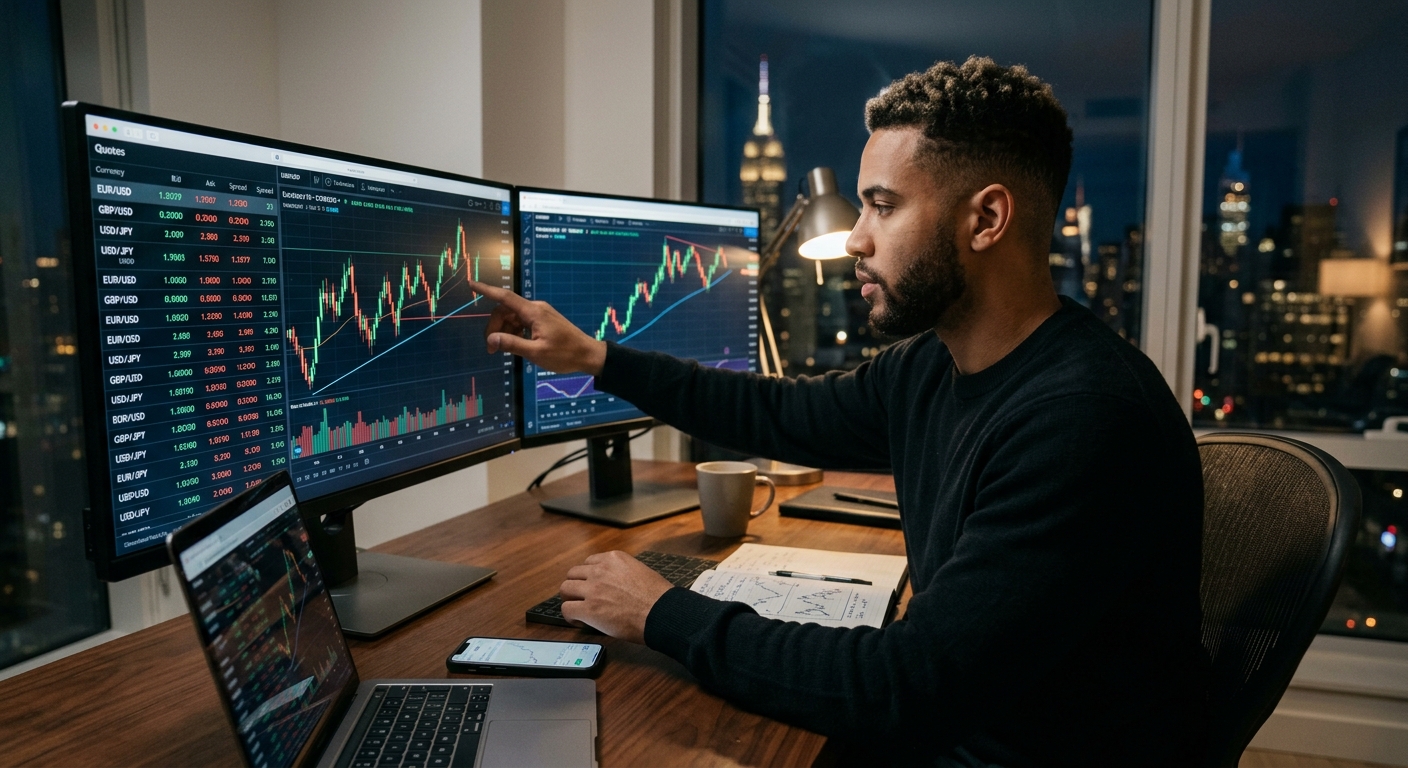
What Is Forex Trading? Guide To Overseas Exchanges
The foreign exchange market is one of the most important financial markets in the global economy. Every day, currencies change hands to facilitate international trade, investment, tourism, corporate payments, and financial speculation.
For businesses, foreign exchange can be an operational necessity. For investors and traders, it can represent an opportunity to speculate on movements between currencies.
But the market is more intricate than simply buying one currency and selling another.
Exchange rates respond to interest rates, inflation, economic growth, central-bank decisions, geopolitical developments, capital flows, market expectations, and countless other factors. The international nature of the market also means that traders operate across different financial centers, regulatory jurisdictions, trading sessions, and technological infrastructures.
For anyone asking what is forex trading, the simplest answer is that it involves buying one currency while simultaneously selling another, usually through a currency pair, with the aim of benefiting from changes in its exchange rate.
The more complete answer requires understanding how the market works, what overseas exchanges mean in the context of forex, how transactions are executed, and what risks participants face.
What Is Forex Trading?
Forex, short for foreign exchange, refers to the global marketplace where currencies are exchanged.
Forex trading involves speculating on the relative value of one currency against another.
Currencies are quoted in pairs because every foreign exchange transaction involves two currencies. For example, EUR/USD represents the euro against the U.S. dollar.
If EUR/USD is quoted at 1.1000, it means one euro is worth 1.10 U.S. dollars.
A trader who expects the euro to strengthen against the dollar may buy EUR/USD. Conversely, someone who expects the euro to weaken against the dollar may sell the pair.
The difference between the opening and closing price determines the trading result, before costs such as spreads, commissions, and financing charges are considered.
This relative structure is fundamental.
There is no universal concept of a currency simply becoming “strong” or “weak” in isolation. Its value is always measured against something else.
How Does the Forex Market Work?
Unlike a conventional stock exchange, forex does not operate through one centralized global marketplace.
Instead, foreign exchange trading primarily occurs through an over-the-counter (OTC) network involving banks, financial institutions, brokers, corporations, investment firms, and other participants.
Major financial centers around the world contribute to this network.
London, New York, Tokyo, Singapore, Hong Kong, and other financial hubs participate in global currency trading.
As trading activity moves between time zones, the forex market can remain active for most of the business week.
This global structure is one of the market’s defining characteristics.
It also explains why forex trading differs from buying shares listed on a single stock exchange.
Understanding Currency Pairs
Every forex transaction involves a currency pair.
The first currency is the base currency.
The second is the quote currency.
Consider GBP/USD.
GBP is the base currency, while USD is the quote currency.
If the pair trades at 1.2500, one British pound is equivalent to 1.25 U.S. dollars.
Currency pairs are generally divided into three broad categories.
Major Currency Pairs
Major pairs typically involve the world’s most heavily traded currencies and usually include the U.S. dollar.
Examples include:
- EUR/USD
- GBP/USD
- USD/JPY
- USD/CHF
- AUD/USD
- USD/CAD
- NZD/USD
These pairs generally attract substantial liquidity.
Minor Currency Pairs
Minor pairs, sometimes called cross-currency pairs, combine major currencies without including the U.S. dollar.
Examples include:
- EUR/GBP
- EUR/JPY
- GBP/JPY
- AUD/JPY
Their trading characteristics can differ from major pairs.
Exotic Currency Pairs
Exotic pairs generally combine a major currency with the currency of an emerging or smaller economy.
Examples can include USD/TRY or USD/ZAR.
These pairs may have wider spreads and greater volatility than some major currency pairs.
Higher potential price movement can come with higher trading costs and risk.
What Does “Overseas Exchanges” Mean in Forex?
The phrase “overseas exchanges” can be slightly misleading when applied to foreign exchange.
Forex is not simply a collection of national stock exchanges where currencies are listed and traded in the same manner as shares.
Instead, forex trading is largely decentralized and OTC.
Nevertheless, traders interact with financial institutions and regulated brokers operating in different jurisdictions around the world.
For example, a trader may be located in one country while using a broker regulated in another jurisdiction, subject to applicable legal restrictions.
This international structure means that understanding the regulatory environment of a trading provider is particularly important.
A trader should know where a broker is regulated, what protections apply to client funds, what products are offered, and which legal entity actually provides the service.
The Role of the U.S. Dollar
The U.S. dollar occupies a particularly important position in global foreign exchange.
Many major currency pairs involve USD.
The dollar also plays a major role in international trade, reserves, commodities, banking, and global finance.
Consequently, developments in the United States can influence currency markets worldwide.
Federal Reserve interest-rate decisions, inflation figures, employment data, economic growth, and changes in expectations regarding monetary policy can all affect currency valuations.
A major U.S. economic announcement can therefore produce movement in currency pairs involving currencies from entirely different regions.
What Causes Currency Prices to Move?
Exchange rates are shaped by supply and demand, but those forces are themselves influenced by a complex collection of economic and financial variables.
Interest Rates
Interest rates are among the most closely watched factors.
When investors expect a country’s interest rates to rise relative to another country’s rates, the currency may attract greater demand.
However, markets frequently respond to expectations rather than merely reacting to decisions after they occur.
Inflation
Inflation influences purchasing power and monetary policy.
Persistent inflation may prompt a central bank to tighten monetary conditions, potentially affecting currency valuations.
The relationship is not mechanical, however.
Markets consider inflation alongside growth, policy expectations, and other variables.
Economic Growth
Stronger economic performance can influence investor expectations about a country’s assets, interest rates, and future capital flows.
Economic weakness can produce the opposite effect.
Again, context matters.
A strong economic figure may already be anticipated by markets, reducing its immediate impact on exchange rates.
Central-Bank Policy
Central banks are among the most influential participants in currency markets.
Institutions such as the Federal Reserve, European Central Bank, Bank of England, and Bank of Japan make decisions that can materially affect interest-rate expectations.
Even speeches and policy statements can move currencies if traders interpret them as signals of future policy.
Geopolitical Events
Political instability, elections, conflicts, trade disputes, sanctions, and diplomatic developments can create substantial currency volatility.
Markets often react rapidly when uncertainty increases.
Market Sentiment
Not every currency movement can be explained by economic statistics.
Investor sentiment matters.
During periods of heightened uncertainty, investors may move toward currencies or assets perceived as relatively defensive.
This can produce significant movements across multiple currency pairs.
How a Forex Trade Is Executed
A retail trader generally accesses the forex market through a broker or trading platform.
The platform displays available prices, commonly showing a bid and ask.
The bid is the price at which the market participant can sell the base currency.
The ask is the price at which the market participant can buy the base currency.
The difference between these prices is the spread.
For example:
EUR/USD
Bid: 1.1000
Ask: 1.1002
The spread is 0.0002.
Depending on the broker and account type, additional commissions may apply.
The trader can then place different types of orders, including market orders and various pending orders designed to execute under specified conditions.
Execution quality can vary according to liquidity, market conditions, technology, broker practices, and the specific instrument being traded.
What Is Leverage?
Leverage allows a trader to control a larger position using a smaller amount of deposited capital.
This is one of the most important concepts in forex.
Suppose a trader has $1,000 and uses leverage to control a position with a significantly greater notional value.
A small favorable price movement can produce a proportionally larger return relative to the initial capital.
The reverse is equally true.
A small unfavorable movement can cause substantial losses.
Leverage therefore magnifies exposure rather than eliminating the need for capital.
It should be approached cautiously, particularly because currency markets can move quickly during periods of heightened volatility.
Margin and Margin Calls
Leverage is closely connected to margin.
Margin represents funds required to support a leveraged trading position.
If market movements cause account equity to fall below required levels, a broker may issue a margin call or automatically close positions according to its policies.
This mechanism is designed to limit credit exposure and prevent losses from escalating indefinitely.
Understanding margin requirements before opening a position is essential.
A trader should know not only how much capital is required to enter a trade but also how much adverse movement the account can withstand.
The Advantages of Trading Forex
Forex has several characteristics that attract market participants.
Global Market Access
The international nature of forex allows traders to access currencies connected to different economies.
High Liquidity
Major currency pairs generally have substantial trading activity, which can support efficient execution under normal market conditions.
Extended Trading Hours
Because trading activity moves through global financial centers, forex is generally available across most of the business week.
Ability to Trade Both Directions
Participants can seek opportunities from both rising and falling currency pairs.
Broad Economic Exposure
Currency movements provide exposure to global macroeconomic developments, including interest rates, inflation, trade, and monetary policy.
These characteristics make forex distinctive.
However, accessibility should never be mistaken for low risk.
The Risks of Forex Trading
The market’s advantages are accompanied by significant risks.
Leverage Risk
Leverage can cause losses to accumulate rapidly.
Market Volatility
Economic announcements and geopolitical events can generate sudden price movements.
Transaction Costs
Spreads, commissions, and overnight financing costs can reduce returns.
Currency Correlation
Trading several related currency pairs does not necessarily provide genuine diversification.
Psychological Risk
Fear, greed, overconfidence, and impulsive decision-making can undermine trading discipline.
Broker Risk
The choice of intermediary matters, particularly in an international and decentralized market.
Regulatory Differences
Protection can vary substantially between jurisdictions.
These risks make risk management an essential part of any serious approach to forex.
Forex Trading Strategies
There is no universal strategy that works under every market condition.
Several broad approaches are commonly used.
Scalping
Scalpers attempt to capture small price movements over very short periods.
This approach can involve numerous transactions and therefore places considerable emphasis on execution costs and discipline.
Day Trading
Day traders generally open and close positions within the same trading day, attempting to capitalize on short-term movements.
Swing Trading
Swing traders may hold positions for several days or weeks while attempting to capture broader price movements.
Position Trading
Position traders typically take a longer-term view based on macroeconomic trends and broader market expectations.
The appropriate approach depends on objectives, experience, available time, risk tolerance, and market conditions.
Fundamental Analysis
Fundamental analysis examines economic conditions that could influence currencies.
A trader might study:
- Central-bank decisions
- Inflation
- Employment
- GDP
- Interest-rate differentials
- Trade balances
- Political developments
- Consumer spending
- Manufacturing activity
The objective is to form an assessment of relative economic strength and future expectations.
For example, if markets anticipate that one central bank will raise interest rates while another is expected to cut them, traders may reassess the relative attractiveness of the currencies involved.
But markets are forward-looking.
The price may already reflect widely anticipated information.
Technical Analysis
Technical analysis takes a different approach.
Rather than concentrating primarily on economic fundamentals, it examines price behavior and market data.
Common tools include:
- Moving averages
- Support and resistance
- Trend lines
- Momentum indicators
- Volatility measures
- Chart patterns
Technical analysis can help traders structure entries and exits.
It does not guarantee that a particular pattern will produce a specific outcome.
Financial markets are probabilistic environments, not deterministic machines.
The Importance of Risk Management
A sophisticated trading strategy can still fail without proper risk management.
Risk management involves controlling how much capital is exposed to any individual trade and to the portfolio as a whole.
Methods can include:
- Limiting position size
- Avoiding excessive leverage
- Using predetermined exit points
- Maintaining sufficient margin
- Diversifying where appropriate
- Establishing maximum loss limits
- Monitoring correlated positions
The objective is not to eliminate losses.
That is impossible.
The objective is to ensure that individual losses do not jeopardize the trader’s ability to continue operating.
Choosing a Forex Broker
Selecting a broker deserves careful attention.
Important considerations can include:
Regulation: Determine which authority supervises the broker and which legal entity holds the account.
Costs: Compare spreads, commissions, financing charges, and other fees.
Execution: Understand how orders are executed and whether slippage can occur.
Trading platform: Evaluate reliability, functionality, and accessibility.
Available instruments: Check which currency pairs and related products are offered.
Client-fund arrangements: Understand how customer money is handled.
Customer support: Reliable assistance can become particularly important during technical or operational problems.
A professional-looking website is not sufficient evidence of reliability.
Regulatory and contractual details matter.
How Beginners Can Approach Forex
Anyone new to forex should first learn the mechanics.
Understand currency pairs.
Learn how spreads work.
Understand leverage and margin.
Study order types.
Learn how overnight financing operates.
Explore fundamental and technical analysis.
Most importantly, understand the possibility of loss.
Practice environments can help newcomers become familiar with trading platforms, although simulated performance cannot perfectly replicate live trading conditions.
A written trading plan can also help reduce impulsive decisions.
It should define what is being traded, why a position might be opened, how much risk is acceptable, and under what circumstances the position will be closed.
Forex Trading Is Not the Same as Easy Money
The accessibility of online trading platforms has sometimes created the impression that forex is an uncomplicated way to generate income.
That assumption is dangerous.
Professional market participants spend substantial resources on research, technology, risk management, execution, and analysis.
Even experienced traders experience losing positions.
The market contains no guaranteed formula.
Successful participation requires an understanding of uncertainty rather than an expectation that uncertainty can be eliminated.
Understanding Overseas Market Sessions
Forex activity changes throughout the day as major financial centers open and close.
Asian trading hours are followed by European activity, which overlaps with North American trading.
These overlapping periods can experience elevated activity because more participants are simultaneously operating in the market.
Different sessions can also have different characteristics.
For example, currencies associated with a particular region may receive greater attention when its domestic financial markets are active.
Understanding trading sessions can help traders evaluate liquidity and volatility.
The Role of Technology
Modern forex trading depends heavily on technology.
Prices can be delivered electronically within fractions of a second.
Automated systems can monitor markets continuously.
Trading platforms can provide charts, economic calendars, analytical tools, and risk-management functions.
Institutional participants may use sophisticated algorithms and high-performance infrastructure.
Yet technology introduces its own risks.
Internet disruptions, platform outages, connectivity problems, and execution delays can affect trading.
A robust operational plan is therefore valuable, particularly for traders using leveraged positions.
Final Thoughts
For anyone asking what is forex trading, the fundamental concept is straightforward: forex trading involves buying and selling currencies against one another in an attempt to benefit from changes in exchange rates.
The market itself, however, is anything but simple.
Foreign exchange operates through a vast international network of banks, institutions, corporations, brokers, investors, and traders. Unlike a single centralized stock exchange, the forex market is predominantly an over-the-counter ecosystem spanning major financial centers around the world.
That international architecture creates considerable opportunities, but it also introduces complexity.
Currency prices are influenced by interest rates, inflation, economic growth, central-bank policy, geopolitical developments, capital flows, and investor sentiment. Leverage can magnify both gains and losses, while trading costs and execution conditions can materially affect results.
Understanding overseas forex markets therefore requires more than learning how to click “buy” or “sell.”
It requires understanding currency pairs, market structure, trading sessions, economic drivers, broker regulation, leverage, margin, transaction costs, and risk management.
Forex can be a sophisticated financial market with genuine applications in international commerce, investment, hedging, and speculation.
It should nevertheless be approached with discipline and realistic expectations.
The most important principle is simple: understand the market before exposing capital to it.
You May Also Like

How to Take Advantage of Cargo Bags

9 ways in which a logistics operator can help your business grow