
whats foreign exchange trading guide to overseas exchanges
What’s Foreign Exchange Trading? A Guide to Overseas Exchanges

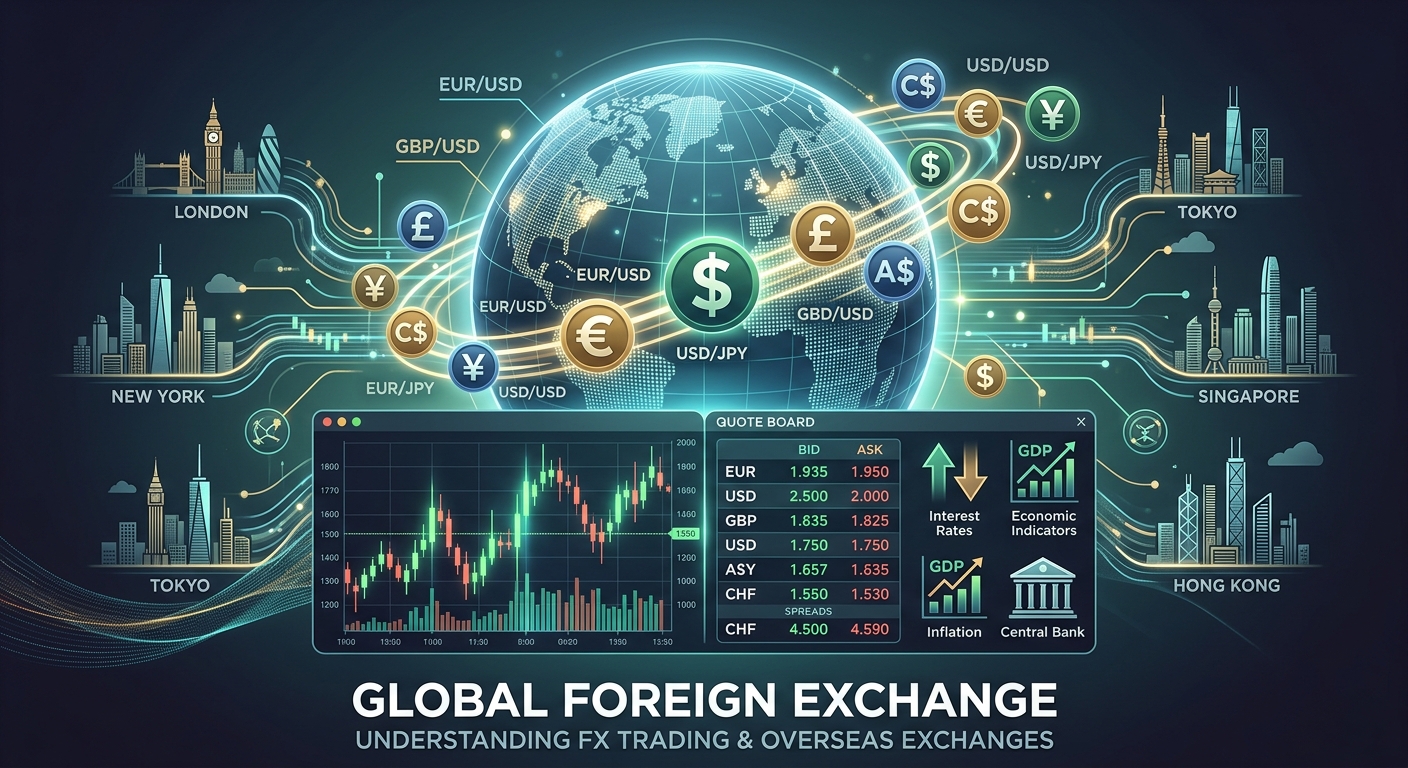
Foreign exchange trading is one of the largest and most geographically dispersed financial activities in the world. Unlike a traditional stock exchange, foreign exchange does not operate through one central marketplace. Instead, currencies are traded through an international network of banks, financial institutions, brokers, corporations, governments, investment firms, and individual participants.
This decentralized structure gives the foreign exchange market its distinctive character.
Trading can take place across different financial centers and time zones, allowing the market to operate almost continuously during the business week. Prices respond to interest rates, economic statistics, geopolitical developments, market expectations, capital flows, and countless other variables.
For anyone trying to understand overseas currency markets, terminology can initially be bewildering. Concepts such as currency pairs, spreads, pips, leverage, spot transactions, forwards, swaps, and liquidity all have specific meanings.
At the center of these concepts is a simple question: what is fx in finance?
FX is short for foreign exchange, referring to the conversion and trading of one currency against another. When a trader buys EUR/USD, for example, the trader is simultaneously buying euros and selling U.S. dollars at the quoted exchange rate.
That basic transaction becomes considerably more sophisticated when it is conducted across international markets.
Understanding Foreign Exchange Trading
Foreign exchange trading involves exchanging one currency for another with the objective of facilitating commerce, managing risk, or potentially benefiting from changes in exchange rates.
Currencies are quoted in pairs because every currency transaction involves two currencies.
Consider EUR/USD.
If EUR/USD is quoted at 1.1000, the quotation indicates that one euro is equivalent to 1.10 U.S. dollars. If the exchange rate subsequently rises to 1.1200, the euro has appreciated relative to the dollar, assuming the quotation convention remains unchanged.
The same principle applies to pairs such as GBP/USD, USD/JPY, USD/CHF, and AUD/USD.
Currency prices fluctuate continuously because market participants continually reassess relative economic conditions.
A stronger-than-expected economic report may support a currency. An unexpected interest-rate decision can produce a rapid repricing. Political uncertainty may increase demand for perceived safe-haven currencies. A shift in commodity prices can affect economies whose exports depend heavily on raw materials.
Foreign exchange is therefore both a financial market and a reflection of international economic expectations.
Why Overseas Exchanges Matter
The phrase “overseas exchange” can be somewhat misleading because the global FX market is not simply a collection of identical stock exchanges located in different countries.
Foreign exchange is predominantly an over-the-counter, or OTC, market.
Transactions can occur through networks linking banks, brokers, electronic trading platforms, and other financial institutions. Major financial centers—including London, New York, Tokyo, Singapore, Hong Kong, and other international hubs—contribute substantial trading activity.
This geographical distribution matters because market conditions can vary according to time zone, liquidity, institutional participation, and regional economic events.
For example, Asian market hours can be particularly relevant for currencies linked to economies in the Asia-Pacific region. European trading hours often bring substantial liquidity to major euro and sterling pairs. U.S. trading hours can produce significant activity in dollar-denominated currencies.
During overlapping sessions, liquidity and trading activity can increase substantially.
The Major Currency Pairs
Foreign exchange markets contain a vast number of currency combinations, but a relatively small group receives substantial international attention.
The most actively traded pairs generally involve major currencies and the U.S. dollar.
Examples include:
EUR/USD — euro against U.S. dollar.
USD/JPY — U.S. dollar against Japanese yen.
GBP/USD — British pound against U.S. dollar.
USD/CHF — U.S. dollar against Swiss franc.
AUD/USD — Australian dollar against U.S. dollar.
USD/CAD — U.S. dollar against Canadian dollar.
NZD/USD — New Zealand dollar against U.S. dollar.
These pairs are often considered highly liquid, meaning buyers and sellers can generally transact with relatively low price friction compared with less frequently traded currency combinations.
There are also cross-currency pairs, such as EUR/GBP or EUR/JPY, which do not directly involve the U.S. dollar.
Then there are emerging-market currencies, which may offer different characteristics, including potentially wider spreads and greater sensitivity to political or economic developments.
How Currency Quotes Work
Understanding quotations is essential.
In a currency pair, the first currency is called the base currency, while the second is the quote or counter currency.
For EUR/USD, the euro is the base currency and the U.S. dollar is the quote currency.
A price of 1.1000 means that one unit of the base currency costs 1.10 units of the quote currency.
The bid is the price at which the market or liquidity provider is willing to buy the base currency. The ask is the price at which the market is willing to sell it.
The difference between these prices is called the spread.
For example:
EUR/USD
Bid: 1.0999
Ask: 1.1001
The spread is 0.0002.
For traders, the spread represents an immediate transaction cost that must be considered when evaluating a position.
What Is a Pip?
A pip is a standardized unit commonly used to describe small movements in an exchange rate.
For many major currency pairs, a pip is the fourth decimal place. However, currency pairs involving the Japanese yen generally use a different convention, with a pip commonly corresponding to the second decimal place.
Suppose EUR/USD moves from 1.1000 to 1.1050.
That represents a 50-pip movement under the conventional quotation system.
Pips allow traders and analysts to describe price movements without repeatedly discussing long strings of decimal figures.
They are also frequently used in discussions about spreads, trading performance, and risk management.
Spot Trading, Forwards, and Swaps
Not all foreign exchange transactions work in the same way.
The spot FX market involves exchanging currencies at an agreed rate, with settlement typically occurring shortly after the transaction according to market conventions.
Forward contracts are different. They involve an agreement to exchange currencies at a predetermined future date and rate.
Forwards are widely used by corporations and financial institutions to hedge currency exposure.
Suppose an international company expects to receive payment in a foreign currency several months from now. If the company is concerned that the currency could depreciate before payment arrives, it may use a forward contract to reduce uncertainty.
Currency swaps represent another form of transaction involving the exchange of currencies and the subsequent reversal of that exchange according to agreed terms.
These instruments illustrate an important point: FX is not exclusively about speculative trading.
It is also a crucial mechanism for managing international financial risk.
Why Companies Use Foreign Exchange Markets
Multinational businesses routinely encounter currency exposure.
A European company purchasing components in U.S. dollars has exposure to EUR/USD movements. A Japanese exporter receiving revenue in euros has exposure to EUR/JPY-related exchange-rate fluctuations. A corporation with subsidiaries in several countries may have multiple currency exposures simultaneously.
Foreign exchange markets help businesses manage these risks.
Without hedging, exchange-rate movements can alter revenue, costs, margins, and reported earnings.
A company may generate strong operating performance and still experience unfavorable financial results because of currency movements.
This makes FX management an important component of international financial planning.
The Role of Central Banks
Central banks have considerable influence over currency markets.
Interest-rate decisions are especially important because changes in interest rates can alter the relative attractiveness of assets denominated in different currencies.
When a central bank raises interest rates, investors may reassess the expected return associated with that currency. Conversely, expectations of lower interest rates can affect capital flows and exchange-rate valuations.
But interest rates are only one element.
Central banks also communicate through policy statements, economic projections, speeches, and other forms of forward guidance. Market participants analyze this communication with remarkable intensity.
A single sentence suggesting that policymakers are becoming more concerned about inflation can trigger substantial movements if it changes expectations about future monetary policy.
Economic Indicators and Currency Markets
Foreign exchange markets are highly sensitive to economic data.
Commonly watched indicators include:
- Inflation
- Employment
- Gross domestic product
- Retail sales
- Industrial production
- Consumer confidence
- Trade balances
- Manufacturing activity
- Interest-rate decisions
The interesting part is that markets generally react to surprises rather than merely to the existence of data.
Suppose economists expect inflation to rise by 2.5%, but the actual figure is 3.2%.
The unexpected difference may influence expectations about future monetary policy. Traders then reassess the currency’s prospects.
In other words, markets do not simply trade the present.
They trade expectations about the future.
Trading Sessions Around the World
Because FX is international, market activity shifts throughout the day.
The main trading regions are commonly associated with Asia-Pacific, Europe, and North America.
When the Asian session is active, currencies such as the Japanese yen, Australian dollar, and New Zealand dollar may experience heightened regional interest.
European trading brings substantial activity to the euro, British pound, Swiss franc, and many major currency pairs.
The North American session frequently produces elevated activity in U.S. dollar pairs.
There are also overlapping periods between major sessions. These overlaps can be significant because multiple pools of liquidity are active simultaneously.
However, greater activity does not automatically mean lower risk.
Important economic announcements can create abrupt movements, wider spreads, and elevated volatility.
Liquidity and Why It Matters
Liquidity describes how readily an asset can be bought or sold without causing substantial changes in its price.
Major currency pairs generally benefit from deep liquidity. This can contribute to comparatively narrow spreads and efficient execution under ordinary market conditions.
Less liquid currencies can behave differently.
A currency may experience wider spreads, larger price gaps, or sharper reactions to relatively modest orders, particularly during periods of stress.
Liquidity can also deteriorate around major announcements or unusual market events.
This means that a trading strategy designed for calm conditions may behave very differently during a volatile period.
Leverage: Opportunity and Exposure
Leverage enables traders to control a larger position with a smaller amount of capital.
That feature can magnify potential gains.
It also magnifies losses.
Suppose an investor controls a position worth $100,000 with a relatively small amount of deposited capital. A modest exchange-rate movement can produce a significant change in the value of the position.
Leverage is therefore not simply a convenience.
It is a risk amplifier.
The mechanics vary considerably among jurisdictions, brokers, account types, and products. Regulatory authorities may also impose specific restrictions designed to limit excessive retail exposure.
Anyone participating in leveraged FX trading should understand the full economic exposure rather than focusing only on the amount initially deposited.
Understanding Overseas Regulation
Accessing an overseas broker or trading platform introduces another layer of complexity.
Financial regulation differs between jurisdictions. Requirements relating to leverage, client-money protection, reporting, licensing, disclosures, and dispute resolution may not be identical across countries.
Before using an overseas financial service, investors should determine:
- Which legal entity operates the account.
- Which regulator supervises that entity.
- How client funds are treated.
- What protections may apply if the firm fails.
- Which dispute-resolution mechanisms are available.
- Whether local restrictions apply to residents of the trader’s country.
Geographic accessibility should never be confused with regulatory equivalence.
A platform being available online does not necessarily mean that it offers the same protections as a locally regulated financial institution.
Common Risks in Foreign Exchange Trading
FX trading carries several forms of risk.
Market Risk
Exchange rates can move rapidly and unpredictably.
Leverage Risk
Leveraged positions can produce losses disproportionate to the trader’s initial capital.
Counterparty Risk
The other party to a transaction or financial contract may fail to meet its obligations.
Liquidity Risk
A position may become more difficult or costly to exit under stressed market conditions.
Operational Risk
Technology failures, incorrect orders, system outages, or communication breakdowns can affect trading.
Regulatory Risk
Changes in regulation or differences between jurisdictions can alter the conditions under which trading occurs.
Behavioral Risk
Emotional decisions can lead to excessive trading, poor position sizing, or abandonment of previously established risk controls.
Recognizing these risks is more useful than assuming that foreign exchange can be reduced to a simple chart-reading exercise.
How to Approach Overseas FX Markets Methodically
A disciplined approach begins before a trade is placed.
First, identify the objective.
Is the purpose speculation, hedging, international payment management, portfolio diversification, or another financial requirement?
Second, understand the instrument.
Different FX products have different settlement mechanics, financing costs, risks, and regulatory characteristics.
Third, assess the currency itself.
Consider monetary policy, inflation, economic growth, political conditions, and external trade dynamics.
Fourth, evaluate transaction costs.
Spreads, commissions, financing charges, conversion fees, and other costs can materially influence outcomes over time.
Finally, establish risk limits before entering a position.
A trading plan that exists only after a loss has occurred is not much of a plan.
A Practical Example
Consider an investor analyzing EUR/USD.
The European Central Bank signals a more restrictive monetary stance while U.S. economic indicators suggest that the Federal Reserve may begin easing policy.
The investor may conclude that the relative interest-rate outlook could become more favorable for the euro.
However, the analysis does not end there.
The investor must consider whether this expectation is already reflected in the exchange rate. If traders have anticipated the policy shift for months, the market may have incorporated much of the information already.
Unexpected developments can also change the picture rapidly.
This illustrates a crucial feature of FX markets: good economic reasoning does not guarantee a profitable trade.
Market prices reflect collective expectations, and those expectations can change quickly.
The Importance of Information Quality
Because currencies respond to global events, information quality matters.
Traders may monitor official central-bank communications, government economic releases, internationally recognized statistical agencies, and reputable market-data providers.
Social media can provide useful signals about sentiment, but it can also amplify rumors and misinformation.
The speed of information is not the same as its reliability.
In foreign exchange, an incorrect headline can influence prices before the underlying claim has even been verified.
A systematic approach to information can therefore be a competitive advantage.
Technology and the Modern FX Market
Technology has radically transformed foreign exchange markets.
Electronic trading systems allow participants to access prices, execute transactions, analyze charts, monitor positions, and automate certain processes.
Algorithmic trading is also widespread among institutional participants.
Modern systems can process large quantities of market information at extraordinary speed.
Yet technological sophistication introduces its own hazards.
Automated strategies can execute rapidly, but they can also amplify mistakes. Poorly configured systems may generate unintended trades. Connectivity problems can interfere with execution. Complex models may perform poorly when market conditions shift.
Technology should therefore be treated as an instrument, not an oracle.
Final Considerations
Foreign exchange trading is often portrayed as a straightforward activity: choose a currency pair, predict whether it will rise or fall, and place a trade.
The reality is considerably more nuanced.
FX is an international financial ecosystem shaped by central banks, corporations, institutional investors, market makers, governments, brokers, and individual traders. Its decentralized nature allows enormous flexibility and continuous global participation, but it also introduces regulatory, operational, liquidity, and counterparty considerations.
Understanding what is fx in finance is therefore only the starting point.
A meaningful understanding of foreign exchange requires familiarity with currency pairs, quotations, spreads, pips, leverage, liquidity, economic indicators, monetary policy, hedging instruments, regulation, and risk management.
Overseas markets can provide access to a broad global financial environment, but access should be approached with due diligence rather than assumption.
The most durable principle is straightforward: understand the instrument before trading it, understand the market before interpreting its movements, and understand the risks before committing capital.
Foreign exchange is global.
Its complexities are equally global.