
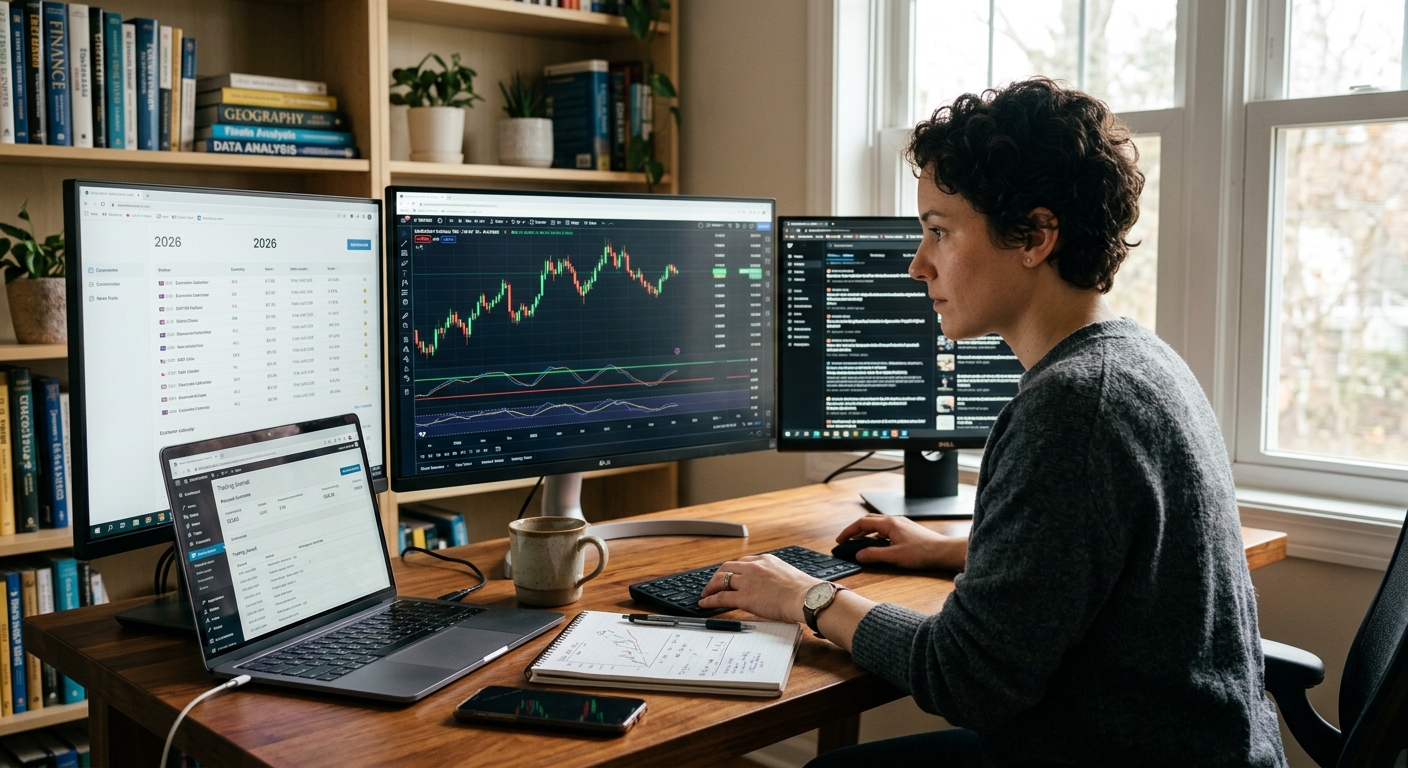
Tips On How To Put Cash Into Forex 2026
The foreign exchange market remains one of the largest and most liquid financial markets in the world. Every day, currencies are exchanged by banks, corporations, governments, institutional investors, and individual traders seeking to manage currency exposure or speculate on exchange-rate movements.
For individuals, entering the forex market can appear deceptively straightforward. Open an account, deposit money, choose a currency pair, and place a trade.
The reality is more intricate.
Forex involves leverage, rapid price fluctuations, transaction costs, economic uncertainty, and the possibility of losing more or faster than expected. Putting cash into forex should therefore begin with education and risk management rather than an immediate attempt to generate returns.
In 2026, traders also have access to sophisticated platforms, automated tools, economic calendars, analytical software, and increasingly powerful data-driven systems. These resources can make market analysis more accessible, but they do not eliminate uncertainty.
The objective is not simply to put money into the market.
It is to understand where the money is going, how much can be lost, and why a particular trade is being considered.
What Does Putting Cash Into Forex Mean?
Forex, short for foreign exchange, involves trading one currency against another.
Currency pairs are quoted in relation to each other. Common examples include:
- EUR/USD
- GBP/USD
- USD/JPY
- USD/CHF
- AUD/USD
- USD/CAD
- NZD/USD
When trading EUR/USD, for example, the trader is speculating on the relative value of the euro against the U.S. dollar.
If the trader believes the euro will strengthen against the dollar, they may take a position designed to benefit from an increase in the exchange rate.
If they expect the euro to weaken, they may take the opposite position.
This relative structure is fundamental.
There is no universal currency that rises or falls in isolation. Forex is fundamentally about relationships between currencies.
Start With Education Rather Than a Deposit
The first step toward putting cash into forex should be understanding how the market operates.
Important concepts include:
- Currency pairs
- Pips
- Bid and ask prices
- Spreads
- Leverage
- Margin
- Position sizing
- Stop-loss orders
- Take-profit orders
- Volatility
- Liquidity
These terms are not merely jargon.
They describe the mechanics that determine how a trade behaves.
For example, leverage allows traders to control a position larger than the amount of capital deposited as margin. While this can magnify potential returns, it can also magnify losses.
A beginner who does not understand leverage may underestimate the financial consequences of a relatively small currency movement.
Education is therefore the first form of risk management.
Determine Whether Forex Fits Your Financial Situation
Forex trading should generally be approached as speculative activity rather than a guaranteed income source.
Before allocating money, consider whether the capital is genuinely available for high-risk trading.
Money needed for essential expenses, debt obligations, emergency reserves, or other important financial commitments should not be exposed casually to speculative positions.
A sensible distinction is useful:
Trading capital is money that can potentially be lost without compromising essential financial stability.
This distinction becomes particularly important when leverage is involved.
A trader who cannot emotionally tolerate losing the money deposited into an account may find it difficult to follow a rational strategy.
Choose a Regulated Forex Broker
Selecting a broker is one of the most consequential decisions when entering forex.
A broker provides access to the trading platform and facilitates transactions, so the quality and regulatory status of the provider matter.
Before opening an account, examine:
- Regulatory authorization
- Trading conditions
- Spreads
- Commissions
- Available currency pairs
- Deposit and withdrawal methods
- Customer support
- Platform reliability
- Margin requirements
- Execution policies
Regulation varies by jurisdiction, so traders should verify the broker’s authorization with the appropriate financial regulator rather than relying solely on marketing claims.
A professional-looking website is not evidence of regulatory legitimacy.
Neither is a promise of unusually high returns.
Understand the Difference Between a Broker and a Trading Platform
The broker and trading platform are related but not necessarily the same thing.
The broker provides market access and account infrastructure.
The platform is the software used to analyze markets and execute trades.
Popular trading platforms can offer features such as:
- Price charts
- Technical indicators
- Order management
- Automated trading tools
- Economic calendars
- Market alerts
- Historical data
A sophisticated interface does not automatically make a trading strategy sophisticated.
Technology is an instrument.
The quality of the decision remains critical.
Begin With a Small Amount
A common mistake among new traders is depositing too much capital before understanding how forex behaves in real conditions.
Starting with a smaller amount can provide an opportunity to experience:
- Real spreads
- Order execution
- Slippage
- Emotional reactions
- Position management
- Platform functionality
The psychological difference between simulated money and real money can be considerable.
A trade that appears effortless in a demo account can feel entirely different when actual capital is exposed.
Starting cautiously allows experience to develop without unnecessarily increasing financial risk.
Use a Demo Account First
A demo account can be useful for learning the mechanics of forex trading.
It allows users to practice:
- Opening positions
- Closing positions
- Setting stop-loss orders
- Setting take-profit orders
- Reading charts
- Testing strategies
However, demo trading has limitations.
There is usually less psychological pressure because the money is not genuinely at risk.
For that reason, demo trading should be viewed as preparation rather than proof of profitability.
A strategy that works on a demo account still needs to be evaluated carefully under realistic conditions.
Understand Leverage
Leverage is one of the most important concepts in forex.
It enables a trader to control a larger position using a smaller amount of capital.
Suppose a trader has $1,000 in an account. Depending on the broker and applicable regulations, leverage could allow exposure considerably larger than the deposited amount.
That sounds attractive.
It is also dangerous.
A relatively modest market movement can have a substantial effect on leveraged positions.
Leverage should therefore be treated as a risk amplifier, not simply as a mechanism for increasing potential profits.
Learn About Margin
Margin is closely connected to leverage.
It represents the amount of capital required to maintain a trading position.
If market movements cause account equity to fall significantly, a broker may require additional funds or close positions according to its margin policies.
Understanding margin requirements before opening a trade is essential.
A trader should know:
- How much margin is required
- How much free margin remains
- What happens when margin becomes insufficient
- Whether positions can be automatically liquidated
Ignoring these details can lead to unpleasant surprises during volatile markets.
Select Currency Pairs Carefully
Not every currency pair behaves the same way.
Major pairs such as EUR/USD and USD/JPY generally have substantial trading activity.
Other pairs can exhibit different characteristics, including wider spreads or greater volatility.
Currency pairs can broadly be considered as:
Major Pairs
These involve some of the world’s most actively traded currencies.
Minor or Cross Pairs
These involve major currencies but exclude the U.S. dollar.
Exotic Pairs
These generally involve one major currency and the currency of a smaller or emerging economy.
Exotic pairs can present distinctive opportunities but may also involve lower liquidity and higher transaction costs.
For beginners, understanding a smaller selection of liquid currency pairs may be more manageable than attempting to trade everything.
Understand What Moves Currency Prices
Currencies respond to numerous economic and geopolitical forces.
Important influences include:
- Interest rates
- Inflation
- Economic growth
- Employment
- Central-bank policy
- Government debt
- Trade balances
- Political developments
- Commodity prices
- Investor sentiment
For example, expectations of higher interest rates can influence demand for a currency.
But markets are forward-looking.
Currency prices can move before an official interest-rate decision because traders are already adjusting expectations.
This is why economic analysis requires attention to both current data and anticipated future conditions.
Follow Central Banks
Central banks play a crucial role in foreign exchange markets.
Institutions such as the Federal Reserve, European Central Bank, Bank of England, Bank of Japan, and other central banks make decisions that can significantly influence currency valuations.
Traders often monitor:
- Interest-rate decisions
- Monetary-policy statements
- Inflation assessments
- Economic forecasts
- Central-bank speeches
- Meeting minutes
A seemingly minor change in central-bank language can cause markets to reassess expectations.
The words surrounding a policy decision can therefore matter almost as much as the decision itself.
Use an Economic Calendar
An economic calendar lists scheduled economic releases.
Important announcements can include:
- Inflation data
- Employment reports
- GDP figures
- Retail sales
- Manufacturing data
- Central-bank decisions
- Consumer-confidence figures
These releases can generate substantial volatility.
A trader holding a leveraged position during a major announcement may experience rapid price movements.
An economic calendar does not predict what will happen.
It identifies when potentially market-moving information is scheduled to arrive.
That alone can be valuable.
Develop a Trading Strategy
Putting cash into forex without a strategy is essentially speculation without structure.
A trading strategy should establish:
- Entry conditions
- Exit conditions
- Position size
- Risk limits
- Preferred currency pairs
- Trading timeframe
- Market conditions that should be avoided
Different approaches may focus on different phenomena.
Some traders use technical patterns.
Others emphasize macroeconomic conditions.
Some combine both.
The most important characteristic is consistency.
A strategy should be sufficiently clear that a trader can determine whether a potential trade actually meets its criteria.
Consider Day Trading Forex Carefully
Day trading forex involves opening and closing positions within relatively short periods, generally without holding them overnight.
The attraction is obvious.
Traders may attempt to capture relatively small intraday movements repeatedly.
However, the frequency of trading can create additional challenges.
These include:
- Transaction costs
- Emotional fatigue
- Overtrading
- Rapid decision-making
- Short-term volatility
- Slippage
- Increased exposure to market noise
Day trading also requires substantial attention.
It should not be assumed that more trades automatically mean more opportunities for profit.
Sometimes the best decision is to wait.
Explore Swing Trading
Swing trading generally involves holding positions for several days or weeks.
This approach can allow traders to focus on broader price movements rather than every intraday fluctuation.
Swing traders may analyze:
- Trends
- Support and resistance
- Economic developments
- Momentum
- Interest-rate expectations
The slower pace can be more compatible with people who cannot continuously monitor markets.
Nevertheless, positions may remain exposed to overnight and weekend developments.
Risk management remains essential.
Learn Technical Analysis
Technical analysis focuses on historical price and volume behavior.
Popular tools include:
- Moving averages
- Relative Strength Index
- MACD
- Bollinger Bands
- Support and resistance
- Trend lines
- Fibonacci retracements
Indicators should not be treated as magical forecasting devices.
They are analytical tools.
A chart covered with numerous indicators can create an illusion of precision without actually improving decision-making.
A relatively simple framework that is thoroughly understood can be more useful.
Learn Fundamental Analysis
Fundamental analysis examines the economic conditions that influence currencies.
Forex traders may monitor:
- Inflation
- Interest rates
- GDP growth
- Employment
- Consumer spending
- Government policy
- Trade balances
For example, if an economy experiences persistent inflation, market participants may anticipate tighter monetary policy.
That expectation could influence the country’s currency.
However, relationships are rarely mechanical.
The same economic report can produce different market reactions depending on what traders had already anticipated.
Establish Risk Per Trade
Risk management should be determined before entering a position.
One approach is to establish a maximum percentage of account capital that can be lost on an individual trade.
The exact percentage depends on the individual’s circumstances and risk framework.
The essential principle is simple:
No single trade should have the power to severely damage the entire account.
This prevents one mistaken analysis from becoming a catastrophic event.
Use Stop-Loss Orders Responsibly
A stop-loss order can help limit losses by automatically closing a position when a specified price level is reached.
However, stop-losses are not guarantees against all losses.
During extremely volatile markets or periods of low liquidity, prices can move rapidly and execution may differ from the expected level.
Nevertheless, predetermined exit points can help prevent emotional decision-making.
The key is to establish the risk level before the trade becomes emotionally charged.
Understand Risk-to-Reward Relationships
A trading strategy should consider both potential gain and potential loss.
For example, a trader might consider whether a setup offers an attractive potential reward relative to the amount being risked.
This does not mean every trade needs a particular mathematical ratio.
It means the potential outcome should be evaluated before capital is committed.
A high probability of winning does not necessarily make a strategy profitable if losses are consistently much larger than gains.
Likewise, a strategy with frequent losses may still work if successful trades are sufficiently large and risk is controlled.
Avoid Overtrading
Overtrading is one of the most common hazards facing active traders.
It can happen when someone:
- Trades out of boredom
- Attempts to recover losses
- Chases price movements
- Takes marginal setups
- Believes more trades mean more profits
Quality matters more than quantity.
If a strategy produces only a few legitimate opportunities each week, forcing additional trades does not improve the strategy.
It simply increases exposure to uncertainty and transaction costs.
Keep a Forex Trading Journal
A journal creates an empirical record of trading decisions.
For every position, record:
- Currency pair
- Entry
- Exit
- Position size
- Stop-loss
- Profit or loss
- Reason for entry
- Market conditions
- Reason for exit
Review the journal periodically.
It may reveal recurring patterns.
Perhaps certain setups perform better during specific market sessions. Perhaps losses occur after emotional decisions. Perhaps a particular currency pair consistently produces poor results.
Data can expose weaknesses that memory conceals.
Understand Trading Sessions
The forex market operates across major financial centers, creating periods of varying activity.
Major sessions include:
- Asian session
- European session
- North American session
When major sessions overlap, liquidity and activity can increase.
The most suitable trading period depends on the strategy and currency pair.
For example, someone trading EUR/USD may pay particular attention to periods when European and U.S. markets are active.
There is no universal “best” session.
Market behavior should be evaluated in relation to the strategy being used.
Be Careful With Trading Signals
Online trading communities frequently promote signals, automated systems, and supposedly proven strategies.
Some may provide useful research.
Others may make exaggerated claims.
Before relying on a signal service, ask:
- How is the strategy generated?
- Is there independently verifiable performance data?
- What are the risks?
- Are losses disclosed?
- Are transaction costs included?
- Is the historical record audited?
- Does the provider guarantee returns?
Guaranteed-profit claims should be treated with particular skepticism.
Financial markets do not provide certainty on demand.
Avoid Excessive Leverage
The possibility of making substantial returns with a relatively small deposit can be psychologically compelling.
It can also encourage reckless behavior.
Excessive leverage turns ordinary market fluctuations into potentially damaging account movements.
A conservative approach to leverage gives the trader greater room to withstand temporary adverse movements.
The goal should be longevity.
A trader who remains solvent has the opportunity to learn and improve.
Protect Against Fraud
Forex attracts legitimate businesses as well as fraudulent schemes.
Warning signs can include:
- Guaranteed profits
- Pressure to deposit immediately
- Unusually high promised returns
- Requests to transfer money to personal accounts
- Unclear regulatory information
- Aggressive recruitment tactics
- Fake testimonials
- Withdrawal difficulties
Before depositing money, verify the broker independently through the relevant regulatory authority.
Do not rely solely on screenshots of licenses or social-media claims.
Review Your Performance Regularly
A trading account should be treated as a measurable system.
Review performance using metrics such as:
- Win rate
- Average winning trade
- Average losing trade
- Maximum drawdown
- Profit factor
- Number of trades
- Trading costs
The goal is not to obsess over every individual outcome.
Instead, look for patterns across a meaningful sample.
One winning trade proves almost nothing.
A large collection of trades provides much more information.
Do Not Confuse Skill With Luck
A short period of profitable trading does not necessarily prove that a strategy works.
Markets can produce favorable outcomes by chance.
A trader may make several successful trades while using a fundamentally flawed strategy.
This is why process evaluation matters.
Ask whether the trade followed the established rules.
If it did, the outcome can be recorded as part of the strategy’s statistical history.
If it did not, a profitable result should not automatically be interpreted as evidence that the deviation was intelligent.
Sometimes bad decisions produce good outcomes.
That does not make them good decisions.
Build a Sustainable Forex Routine
A sustainable approach to forex can be surprisingly uneventful.
A routine might involve:
Before Trading
Review the economic calendar, market conditions, open positions, and relevant currency developments.
During Trading
Wait for predefined setups and manage existing positions according to established rules.
After Trading
Record results and identify deviations from the plan.
Weekly
Review performance and determine whether the strategy is behaving as expected.
This structure creates consistency.
It also reduces the temptation to react to every market fluctuation.
Think Long Term
The goal of learning forex should not necessarily be to generate immediate income.
Markets reward patience unevenly.
Some periods provide numerous opportunities.
Others provide very few.
A trader focused solely on making money every day may feel compelled to trade even when conditions are unfavorable.
A process-oriented trader can accept inactivity.
That distinction is important.
The market does not owe anyone a daily opportunity.
Final Thoughts
Putting cash into forex in 2026 requires considerably more than opening a brokerage account and selecting a currency pair.
It requires an understanding of market mechanics, leverage, margin, economic forces, trading costs, risk management, and personal financial circumstances.
The first priority should be education.
The second should be capital preservation.
Only after those foundations are established should strategy development and active trading become the focus.
Different approaches—including day trading forex, swing trading, technical analysis, and fundamental analysis—can be used to interpret currency markets. None should be regarded as a guaranteed route to profit.
A disciplined forex approach is built around clearly defined rules.
Know why a trade is being entered. Know how much can be lost. Understand the factors that could invalidate the analysis. Keep records. Review results. Avoid excessive leverage. And recognize that staying out of the market is sometimes the most rational position available.
Forex can provide substantial opportunities, but those opportunities exist alongside substantial risks.
The most durable approach is therefore not to ask how much money can be put into forex.
The more important question is how much capital can be responsibly exposed, what process will govern its use, and whether the potential reward justifies the risk being accepted.
That shift—from chasing returns to managing decisions—is the foundation of a more disciplined approach to forex trading in 2026.


You May Also Like

Building a Skilled Workforce through Internal Training Initiatives

How to Take Advantage of Cargo Bags