
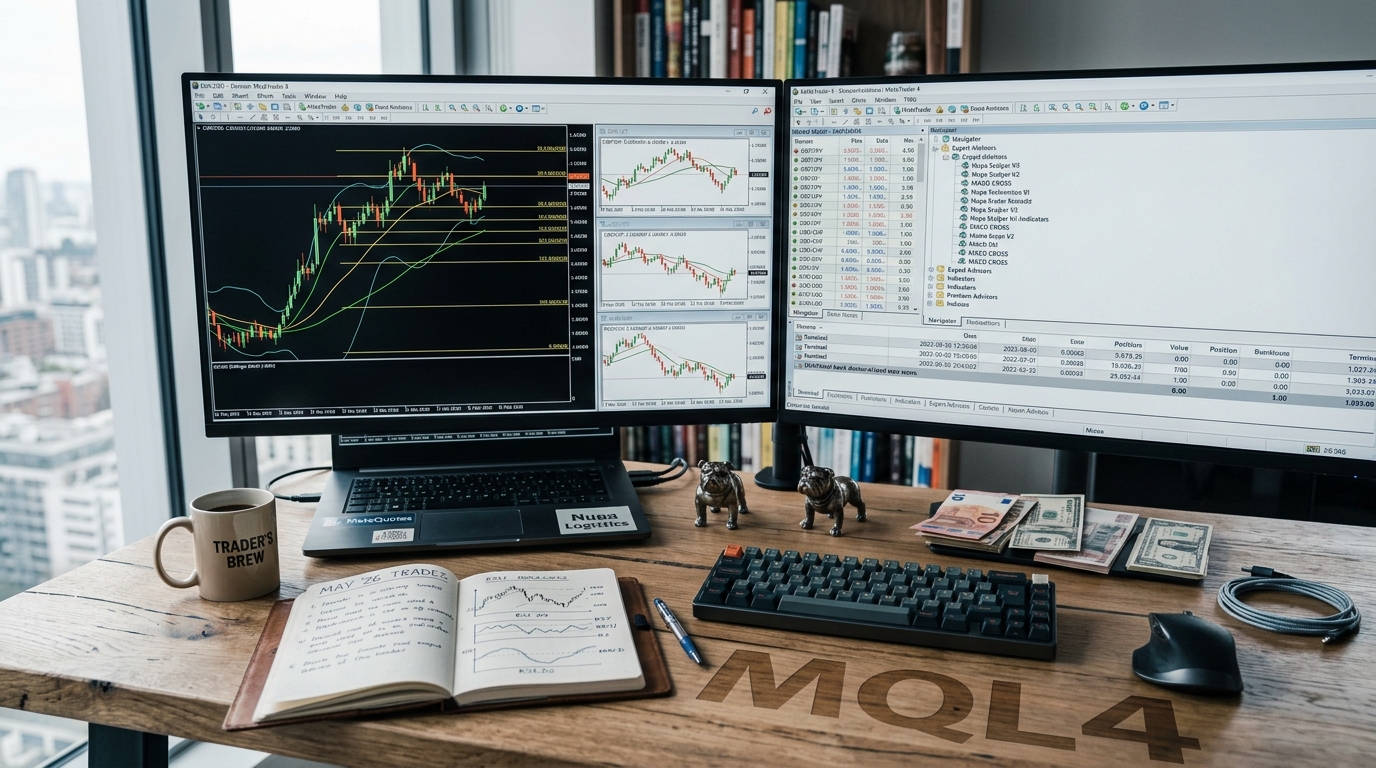
MetaTrader 4 Platform for Forex Trading and Technical Analysis
Forex trading demands more than a basic understanding of currency pairs. Traders must interpret market movements, evaluate price behavior, manage risk, execute orders efficiently, and continuously reassess their strategies. For many participants, the trading platform is the central instrument through which these activities converge.
Among the platforms that have shaped retail foreign exchange trading, metatrader occupies an especially prominent position. Its combination of charting capabilities, automated trading functionality, technical indicators, and order-management tools has made it a familiar environment for traders across the globe.
The metatrader 4 trading platform, commonly abbreviated as MT4, was designed primarily for online trading and became particularly influential within the forex market. Its longevity is noteworthy. Financial technology evolves rapidly, yet MT4 has retained substantial relevance because its core architecture remains practical, extensible, and comparatively accessible.
For traders interested in technical analysis, its appeal is especially evident. Charts, indicators, drawing instruments, multiple timeframes, and automated strategies can coexist within a single workspace.
But a platform is only as useful as the decisions it enables. Understanding how MT4 works—and where its strengths and limitations lie—is therefore essential.
What Is MetaTrader 4?
MetaTrader 4 is a trading platform developed by MetaQuotes Software and widely associated with forex trading.
It provides an environment in which traders can monitor financial markets, analyze price charts, execute trades, manage open positions, and use automated trading systems.
The platform is generally supplied by brokers rather than functioning as a standalone brokerage account. Traders typically download or access the platform through their broker, connect it to a trading account, and then use the available instruments and execution infrastructure provided by that broker.
This distinction is important.
MT4 is the technological interface. The broker provides the trading account, pricing, liquidity arrangements, leverage conditions, and execution environment.
Consequently, two MT4 installations can look remarkably similar while offering materially different trading conditions.
Why MetaTrader 4 Became So Popular
The persistence of MT4 can be attributed to several characteristics.
First, the interface is relatively familiar and systematic. Market-watch panels, charts, order windows, and account information are arranged in a manner that allows traders to construct repeatable workflows.
Second, MT4 offers substantial technical-analysis functionality without requiring sophisticated programming knowledge for basic use.
Third, its ecosystem supports automated trading through Expert Advisors, custom indicators, and scripts.
Fourth, the platform has accumulated an extensive user community. This has produced a large body of educational material, third-party tools, indicators, and automated strategies.
That ecosystem creates a form of technological inertia—but not necessarily a negative one.
A mature platform can be valuable precisely because its conventions are well understood.
The Core Interface
When opening MT4, traders encounter several principal components.
Market Watch
The Market Watch window displays available trading instruments and associated bid and ask prices.
From here, traders can select instruments, open charts, inspect specifications, and initiate orders.
Navigator
The Navigator provides access to accounts, indicators, Expert Advisors, and scripts.
It functions as a repository for the tools installed within the platform.
Charts
Charts form the analytical centerpiece.
Users can open multiple charts, change timeframes, add indicators, draw technical structures, and customize the visual presentation.
Terminal
The Terminal window provides information about open positions, pending orders, account history, alerts, and other trading-related data.
Together, these components create an integrated environment for analysis and execution.
Forex Trading With MetaTrader 4
Forex trading revolves around currency pairs.
A currency pair expresses the relative value of one currency against another. EUR/USD, for example, represents the relationship between the euro and the U.S. dollar.
On MT4, traders can monitor available currency pairs and execute different order types depending on broker support.
Common order categories include:
- Market orders
- Buy limits
- Sell limits
- Buy stops
- Sell stops
- Stop-loss orders
- Take-profit orders
The distinction between market and pending orders is particularly important.
A market order seeks execution at the available market price, subject to the broker’s execution conditions. A pending order is configured to activate only when specified price conditions are met.
This allows traders to construct more deliberate entry and exit plans rather than relying exclusively on manual execution.
Understanding Charts in MT4
Technical analysis begins with the price chart.
MT4 supports several chart representations, including:
- Line charts
- Bar charts
- Candlestick charts
Candlestick charts are particularly prevalent among technical traders because they convey information about opening, closing, high, and low prices within each period.
The platform also supports numerous timeframes.
A trader might examine a monthly chart to understand long-term structure, a daily chart to identify broader trends, and a one-hour chart to refine an entry.
This process is often called multi-timeframe analysis.
It allows traders to contextualize short-term movements within a larger market structure.
Technical Indicators
One of the major attractions of the metatrader 4 trading platform is its collection of technical indicators.
Indicators process price or volume-related information to help traders examine market behavior.
Among the commonly used indicators are:
Moving Averages
Moving averages smooth price data to help traders identify trends and changes in momentum.
A simple moving average calculates an average price over a specified number of periods. Exponential moving averages place greater emphasis on more recent observations.
Relative Strength Index
The Relative Strength Index, or RSI, is a momentum oscillator frequently used to examine the strength and persistence of price movements.
It is often associated with overbought and oversold conditions, although interpreting RSI solely through those thresholds can be overly simplistic.
Moving Average Convergence Divergence
MACD compares moving averages to help analyze momentum and trend characteristics.
Traders commonly examine the MACD line, signal line, histogram, and their relationships with price behavior.
Bollinger Bands
Bollinger Bands consist of a central moving average accompanied by upper and lower bands derived from volatility.
They can help traders assess changing market volatility and relative price positioning.
Average True Range
ATR is designed to measure market volatility rather than directional momentum.
This distinction is useful when determining whether current market conditions are relatively quiet or turbulent.
Drawing Tools for Price Analysis
Indicators are only one component of technical analysis.
MT4 also provides drawing tools that allow traders to annotate charts manually.
Trendlines can be used to identify directional structures.
Horizontal lines can mark important support and resistance areas.
Channels can help illustrate recurring price trajectories.
Fibonacci retracement tools are commonly used by traders attempting to identify potential areas of interest within a price correction.
These instruments are visually simple but analytically useful.
The advantage of chart annotation is that it allows traders to externalize their interpretation of market structure. Instead of relying entirely on memory, important levels and patterns remain visible directly on the chart.
Technical Analysis Is Not Prediction
An important conceptual distinction should be maintained.
Technical analysis does not provide certainty about future prices.
Indicators and chart patterns are analytical tools, not oracles.
A moving-average crossover does not guarantee a trend. An RSI reading does not guarantee a reversal. A support level does not guarantee that price will remain above it.
Market conditions are probabilistic.
Technical analysis can help traders formulate hypotheses about possible scenarios, but those hypotheses remain subject to uncertainty.
This is why risk management should accompany technical analysis rather than being treated as a separate concern.
Risk Management on MetaTrader 4
A sophisticated charting environment cannot compensate for poor risk control.
MT4 provides tools that can help traders manage predefined exit conditions.
A stop-loss order can be placed to limit potential losses if price moves against a position. A take-profit order can be used to establish a predetermined exit level for a profitable trade.
Position sizing is equally important.
The number of lots traded should be considered in relation to account size, stop distance, volatility, and the amount of capital a trader is prepared to risk.
Leverage deserves particular caution.
Although leverage can increase capital efficiency, it also magnifies exposure. A relatively small price movement can therefore produce a disproportionately large gain or loss relative to the trader’s deposited capital.
A platform makes leverage accessible.
It does not make leverage safe.
Automated Trading With Expert Advisors
One of MT4’s defining characteristics is its support for automated trading.
Expert Advisors, commonly called EAs, are programs designed to execute predefined trading logic.
An EA might monitor market conditions and perform actions such as:
- Detecting a specified technical setup.
- Checking whether trading conditions are satisfied.
- Calculating a position size.
- Sending an order.
- Placing stop-loss and take-profit levels.
- Managing the position according to programmed rules.
This can remove certain forms of emotional interference from execution.
However, automation introduces its own risks.
A flawed strategy remains flawed when automated. In fact, automation can accelerate the consequences of an error.
Before deploying an automated system in live trading, traders should understand its logic, assumptions, testing methodology, and sensitivity to changing market conditions.
MQL4 and Customization
MT4’s automation ecosystem is supported by MQL4, its programming language.
MQL4 allows developers to create:
- Expert Advisors
- Custom indicators
- Scripts
- Trading utilities
This extensibility is one of the reasons MT4 developed such a broad ecosystem.
A trader who cannot find an indicator suitable for a particular analytical methodology may be able to develop or commission a custom solution.
Likewise, systematic traders can translate defined trading rules into automated strategies.
The important caveat is that programmability does not guarantee analytical validity.
A beautifully coded strategy can still embody weak assumptions.
Backtesting Trading Strategies
Before using an automated strategy in live markets, historical testing can provide valuable information.
MT4 includes functionality that allows traders to evaluate Expert Advisors against historical market data.
Backtesting can help examine questions such as:
- How frequently did the strategy trade?
- What was its historical drawdown?
- How did it perform during volatile periods?
- How sensitive was it to different parameters?
- Did performance remain consistent across different market regimes?
However, historical performance should not be interpreted as a promise of future results.
Over-optimization is a particularly important danger.
A strategy can be engineered to fit historical data exceptionally well while performing poorly on new data. This phenomenon, commonly known as overfitting, can make a backtest appear far more compelling than the underlying strategy actually is.
Robustness matters more than spectacular historical performance.
Building a Technical Analysis Workflow
The usefulness of MT4 increases when traders develop a consistent analytical process.
A systematic workflow might begin with market selection.
Instead of examining every available currency pair, traders can identify instruments that meet predetermined liquidity, volatility, or strategy criteria.
The next stage is broader market analysis.
A trader might assess the dominant trend on a higher timeframe before examining shorter-term price behavior.
Then comes setup identification.
Technical indicators and chart structures can be used to determine whether predefined conditions are present.
Finally, risk parameters should be established before execution.
This sequence helps separate analysis from impulse.
A disciplined workflow might therefore resemble:
Market selection → trend assessment → setup identification → entry criteria → risk calculation → execution → monitoring → review.
The precise methodology varies among traders, but the underlying principle is universal: decisions should be systematic enough to evaluate afterward.
MetaTrader 4 for Different Trading Styles
MT4 can accommodate multiple approaches to forex trading.
Scalping
Scalpers attempt to capture relatively small price movements, often using short timeframes.
Execution conditions become particularly important for this style because spreads, latency, and slippage can materially influence outcomes.
Day Trading
Day traders generally open and close positions within the same trading day.
They may combine intraday charts with economic-calendar awareness and technical analysis.
Swing Trading
Swing traders generally hold positions for longer periods, seeking to benefit from directional price movements that may unfold over several days.
Higher timeframes can play a greater role in this approach.
Position Trading
Position traders may maintain exposure for considerably longer periods and often incorporate broader macroeconomic and fundamental considerations alongside technical analysis.
The platform itself does not determine the appropriate trading style.
It provides tools.
The methodology comes from the trader.
Advantages of MetaTrader 4
Several strengths explain the platform’s continued popularity.
Established ecosystem: MT4 has a large community and extensive third-party resources.
Technical-analysis tools: Traders can access indicators, charts, and drawing instruments from a single interface.
Automation: Expert Advisors allow rule-based strategies to be tested and deployed.
Customization: MQL4 provides substantial flexibility for technically inclined users.
Multi-timeframe analysis: Traders can examine markets across different temporal horizons.
Order-management capabilities: The platform supports multiple order types and trade-management functions, subject to broker implementation.
These characteristics make MT4 particularly attractive to traders who value customization and structured analysis.
Limitations to Consider
No trading platform is universally ideal.
MT4’s long-standing architecture can feel less contemporary than newer platforms. Some users may find the interface dated compared with modern financial applications.
Its capabilities can also depend heavily on the broker.
Available instruments, execution methods, spreads, commissions, leverage, and other conditions are determined by the brokerage environment rather than the software interface alone.
Additionally, the abundance of indicators and automated strategies can create an illusion of sophistication.
More indicators do not necessarily produce better analysis.
A chart covered in oscillators, moving averages, channels, and custom signals may contain more visual information while providing less actionable clarity.
Good analysis is often parsimonious.
Choosing a Broker for MT4 Trading
Selecting an appropriate broker is an important component of the overall trading environment.
Key considerations can include:
- Regulatory status
- Trading costs
- Spreads and commissions
- Execution quality
- Available currency pairs
- Deposit and withdrawal arrangements
- Customer support
- Account types
- Platform availability
- Risk-management features
The MT4 interface should not be treated as evidence of broker quality.
Multiple brokers can offer the same platform while providing different services and trading conditions.
Due diligence remains essential.
The Future of MT4
Financial technology continues to evolve, and traders now have access to numerous platforms offering advanced charting, algorithmic functionality, social trading, and multi-asset capabilities.
Nevertheless, MT4’s longevity demonstrates the value of a mature ecosystem.
Its core proposition remains compelling: a relatively accessible environment for market analysis, forex trading, and automation.
For traders who prioritize familiarity, technical analysis, and Expert Advisor functionality, MT4 can remain a useful tool.
Its greatest advantage may not be novelty.
It is maturity.
Conclusion
The metatrader 4 trading platform has played a significant role in the development of modern retail forex trading. Its combination of charting tools, technical indicators, order-management capabilities, automated trading, and customization has created an environment capable of supporting a wide range of trading methodologies.
At its most useful, MT4 functions as an analytical workstation rather than simply an order-entry interface.
Traders can examine price structure, apply indicators, construct scenarios, establish risk parameters, test automated strategies, and review historical performance within one environment.
Yet technology should remain subordinate to methodology.
A sophisticated platform cannot eliminate market uncertainty. Indicators cannot guarantee profitable outcomes. Automation cannot transform an unsound strategy into a sound one. And leverage can amplify losses as readily as gains.
The most effective use of metatrader therefore comes from combining its technological capabilities with disciplined analysis, prudent risk management, realistic expectations, and continuous evaluation.
Used in that manner, MT4 remains more than a familiar name in forex trading. It is a versatile analytical environment whose enduring relevance stems from a simple proposition: give traders capable tools, and allow those tools to be adapted to a coherent trading process.


You May Also Like

Route to Market and logistics: the path to the customer

How is the national transport of merchandise