
The Phenomenon of American Football: Unraveling Its Enduring Popularity
American football is more than a sport.
For millions of people across the United States, it is a weekend ritual, a family tradition, a social gathering, a source of civic pride, and an enduring part of popular culture. From youth leagues and high-school stadiums to the spectacle of the Super Bowl, football occupies a peculiar and powerful place in American life.
It is loud. Dramatic. Tactical. Occasionally bewildering.
And remarkably resilient.
The National Football League (NFL) has transformed professional football into a vast entertainment industry, while college football has cultivated generations of intensely loyal supporters. High-school football, meanwhile, remains deeply embedded in many local communities.
But what explains this extraordinary appeal?
Why does a game involving eleven players on each side, elaborate formations, frequent stoppages, specialized positions, and a vocabulary that can sound almost cryptographic to newcomers inspire such devotion?
The answer lies in a mixture of history, competition, identity, entertainment, community, and tradition.
The Origins of American Football
American football developed from earlier forms of rugby and association football during the nineteenth century.
College institutions played an important role in shaping the emerging sport. Rules gradually evolved, distinguishing the American version from its European relatives.
Walter Camp, often called the “father of American football,” played a significant role in establishing features that became fundamental to the modern game, including the line of scrimmage and the system of downs.
The sport became progressively more organized.
Professional football eventually emerged, and the formation of the American Professional Football Association in 1920—later renamed the NFL—provided the foundations for the modern professional game.
What began as a relatively rough collegiate pastime developed into one of America’s most commercially successful sports.
Why Is American Football So Popular?
The enduring popularity of American football cannot be attributed to one factor.
Its appeal is multifaceted.
Football combines physical confrontation with strategic complexity. It offers individual heroics while simultaneously emphasizing collective execution. A single play can last only a few seconds, yet those seconds may contain layers of deception, positioning, timing, and tactical calculation.
That combination makes football unusually rich as both a spectator sport and a cultural phenomenon.
There is something for almost everyone.
Some fans love the athleticism.
Others enjoy tactical analysis.
Some follow individual players.
Others support their hometown team with almost tribal enthusiasm.
And many simply enjoy the social experience surrounding the game.
The Culture of Football in America
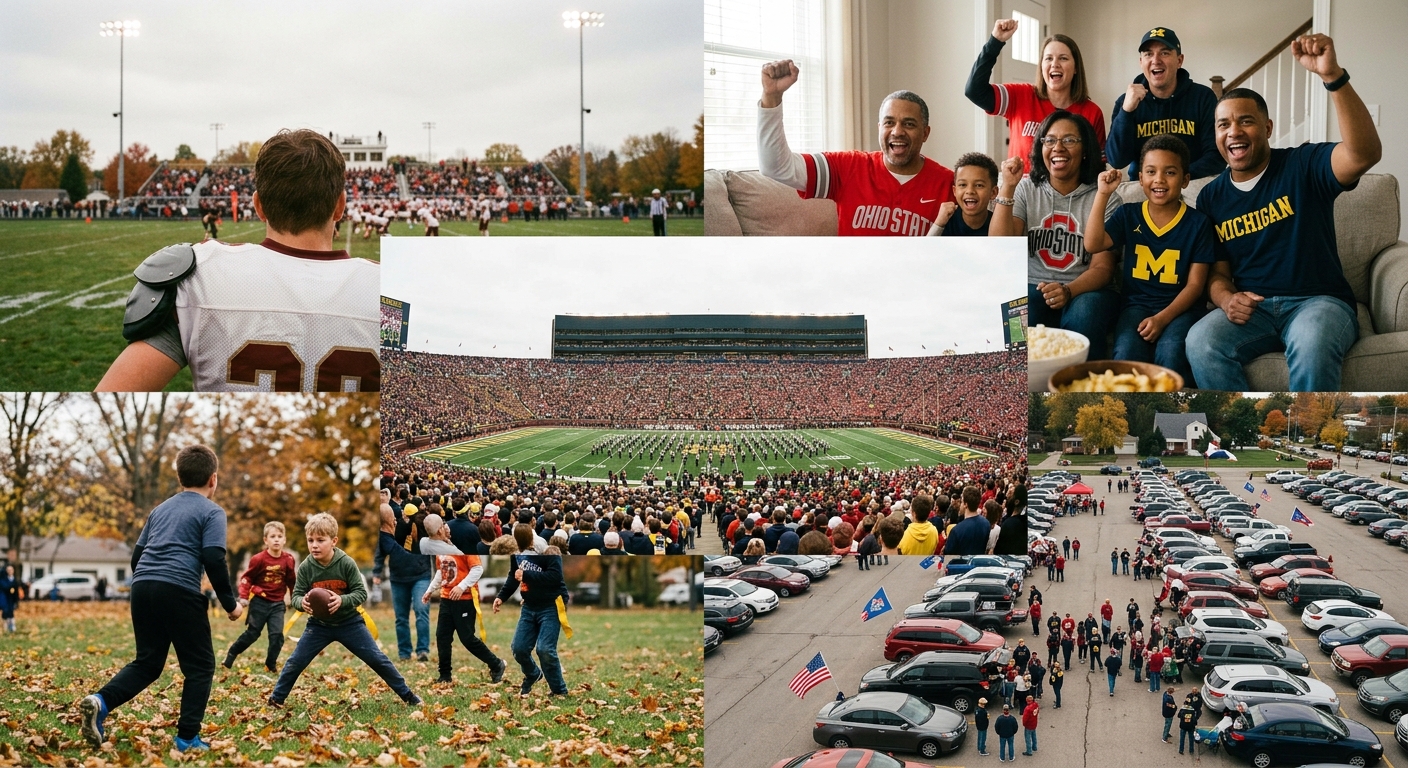
The culture of football in america is particularly distinctive because the sport extends well beyond professional stadiums.
Football exists in schools, neighborhoods, universities, workplaces, television broadcasts, sports bars, fantasy leagues, video games, merchandise stores, and family conversations.
For many Americans, football is associated with specific moments of the year.
Autumn weekends.
Friday-night high-school games.
Saturday college matchups.
Sunday NFL broadcasts.
The Super Bowl in winter.
These recurring events create a cultural calendar.
Football becomes something people anticipate together.
High-School Football and Community Identity
High-school football occupies a special position in many American communities.
In smaller towns, the local team can become a focal point of communal identity.
Students play.
Families attend.
Teachers participate.
Local businesses support the team.
Residents gather in the stands.
A Friday-night game can therefore become much more than an athletic contest.
It becomes a community event.
The stadium provides a shared physical space where different generations interact. Parents may watch their children play on the same field where they once competed themselves.
That continuity creates a powerful sense of tradition.
College Football: Tradition on a Grand Scale
College football amplifies many of these characteristics.
Universities have developed enormous sporting traditions around their teams.
Rivalries can persist for generations.
The University of Alabama, Ohio State University, University of Michigan, University of Texas, Notre Dame, and many other programs have fan bases extending far beyond their campuses.
College football also has an unusual relationship with place.
A university team often represents not merely an institution but a state, region, city, or cultural identity.
That makes rivalries emotionally potent.
The result is a peculiar form of sporting allegiance in which a game can become a proxy for regional pride.
The Power of Rivalries
Rivalries are among the most effective engines of sports fandom.
A regular game can be entertaining.
A rivalry game can feel existential.
The history behind the contest gives every play additional meaning. Previous victories, controversial decisions, famous players, and embarrassing defeats become part of the mythology.
Rivalries also create narratives that survive beyond individual seasons.
Players graduate.
Coaches leave.
Teams change.
The rivalry remains.
This continuity helps transform sporting events into cultural institutions.
The NFL and the Business of Spectacle
Professional football has developed into an enormous entertainment enterprise.
The NFL combines sport with television, advertising, merchandising, sponsorship, digital media, fantasy sports, and live entertainment.
The Super Bowl represents the culmination of this model.
It is not simply a championship game.
It has become a major cultural event involving advertising campaigns, celebrity performances, parties, elaborate broadcasts, and extensive media coverage.
Even people who rarely watch football may pay attention to the Super Bowl.
That phenomenon demonstrates the NFL’s ability to transcend conventional sporting boundaries.
Why Football Is So Well Suited to Television
American football may appear complicated when watched live, but television has transformed the viewing experience.
Broadcasts provide:
- Multiple camera angles
- Instant replays
- Statistical graphics
- Player information
- Tactical explanations
- Commentary
- Slow-motion analysis
The pauses between plays also give broadcasters opportunities to explain what happened.
A viewer can watch the quarterback’s decision, replay the defensive formation, and examine the resulting play from several perspectives.
The game becomes partly athletic contest and partly analytical puzzle.
The Strategic Complexity of Football
Football rewards viewers who enjoy strategy.
Before the ball is snapped, both teams are already engaged in a tactical contest.
The offense attempts to determine the defensive alignment.
The defense attempts to disguise its intentions.
Quarterbacks read defensive formations.
Coaches adjust play calls.
Receivers modify routes.
Defensive players react to motion and formations.
A successful play can therefore depend on decisions made before the physical action even begins.
This cerebral component distinguishes football from the stereotype of a purely physical sport.
The Importance of the Quarterback
The quarterback occupies a uniquely prominent role.
Quarterbacks are often treated as the intellectual center of an offense.
They may be responsible for:
- Reading defensive formations
- Changing plays
- Managing the clock
- Passing
- Coordinating with teammates
- Making rapid decisions under pressure
A quarterback can become a cultural icon.
The position combines leadership, technical skill, physical courage, and psychological resilience.
Great quarterbacks can define eras.
Their performances become part of the historical memory of the sport.
The Drama of Uncertainty
Football also excels at creating suspense.
A game can appear nearly decided and then change dramatically within seconds.
A defensive interception can reverse momentum.
A long touchdown can transform the atmosphere.
A missed field goal can decide a championship.
The relatively limited number of possessions makes individual plays especially consequential.
Every mistake matters.
Every opportunity can disappear quickly.
This scarcity of decisive moments gives football an almost theatrical quality.
The Psychology of Fandom
Sports fandom is partly about belonging.
Supporting a team creates membership in a community.
Fans use “we” when discussing their teams.
“We won.”
“We need a better defense.”
“We’re going to the playoffs.”
Technically, the fan did not make the tackle or throw the touchdown pass.
Yet emotionally, the boundary between individual and team becomes blurred.
This phenomenon is one of the central reasons sports can become so meaningful.
A team becomes an extension of personal and collective identity.
Family Traditions
Football fandom is frequently inherited.
A parent introduces a child to a team.
The child learns the team’s history.
The family watches games together.
Eventually, the child develops preferences of their own.
Decades later, the ritual may continue with another generation.
This creates cultural continuity.
A team’s history becomes intertwined with family history.
A particular championship may be remembered alongside childhood memories. A famous game may become a story repeatedly told at family gatherings.
Sport becomes an archive of personal experience.
Food, Parties, and Social Rituals
Football’s popularity is also connected to its social atmosphere.
Game days often involve:
- Barbecues
- Pizza
- Snacks
- Tailgating
- Parties
- Team merchandise
- Music
- Friendly arguments
- Fantasy football
The social ritual can sometimes be as important as the competition itself.
People gather because there is a game, but the gathering becomes an event in its own right.
Football therefore functions as a social catalyst.
Fantasy Football
Fantasy football has added another layer of engagement.
Instead of following only one team, participants track individual players across the league.
A fan may become interested in games involving teams they would otherwise ignore because a particular player is part of their fantasy roster.
Fantasy football transforms statistics into a competitive experience.
Passing yards, touchdowns, receptions, rushing attempts, interceptions, and other metrics suddenly acquire personal significance.
It encourages fans to learn about players across the league.
The Digital Transformation of Football
Social media has dramatically changed how fans interact with the sport.
Fans can now:
- Watch highlights almost immediately
- Discuss games in real time
- Follow players directly
- Analyze statistics
- Create memes
- Debate coaching decisions
- Participate in online communities
The traditional sports audience watched a game and discussed it afterward.
The modern audience may participate continuously before, during, and after the game.
Football has become a persistent digital conversation.
The Economics Behind the Phenomenon
Football’s popularity also has significant economic consequences.
The industry generates revenue through:
- Broadcasting rights
- Ticket sales
- Sponsorship
- Advertising
- Merchandise
- Licensing
- Hospitality
- Digital media
The enormous television audiences attract advertisers.
Advertisers attract broadcasters.
Broadcasters provide revenue to leagues.
Revenue supports teams and players.
This creates a powerful commercial ecosystem.
The economics of professional football are therefore inseparable from its cultural influence.
The Role of Stadiums
Stadiums create an experience that television cannot fully reproduce.
The crowd noise.
The marching bands.
The mascots.
The lights.
The enormous screens.
The collective reaction to a touchdown.
Being physically surrounded by thousands of supporters creates an emotional intensity that is difficult to replicate elsewhere.
Stadium architecture is increasingly designed around this experience.
Modern venues are entertainment complexes as much as sporting facilities.
Football as American Storytelling
Football also lends itself naturally to storytelling.
The sport produces heroes, underdogs, rivalries, comebacks, failures, redemption, and controversy.
A team can struggle for years before reaching a championship.
A previously overlooked player can become a star.
A veteran can return from injury.
A rookie can transform a franchise.
These narratives make sports compelling because they mirror familiar human themes.
The scoreboard provides the ending.
The season provides the story.
Controversies and the Future of Football
American football’s popularity exists alongside serious debates.
Concerns about player safety, especially head injuries and long-term health consequences, have changed discussions around the sport.
Rules and equipment have evolved.
Medical protocols have become more prominent.
Youth football has also attracted scrutiny.
These debates matter because the sport’s future depends partly on its ability to address legitimate concerns while preserving the elements that make it compelling.
Popularity should not prevent scrutiny.
In fact, highly influential institutions require greater scrutiny precisely because their cultural reach is so extensive.
Football and Changing Demographics
American society continues to evolve, and football’s audience is evolving with it.
Teams increasingly recognize the importance of reaching broader audiences.
Women’s participation in football fandom, fantasy sports, sports media, coaching, officiating, and administration has grown.
International interest has also expanded.
The NFL has invested in games and marketing outside the United States, reflecting an ambition to make American football more globally recognizable.
The sport remains distinctly American, but its audience is becoming increasingly international.
Why the Sport Endures
American football has survived and prospered because it offers several experiences simultaneously.
It is a competition.
It is entertainment.
It is strategy.
It is spectacle.
It is social ritual.
It is tradition.
It is identity.
Few cultural activities combine all of these dimensions so effectively.
A person can watch football for entirely different reasons from another fan sitting beside them.
One might be fascinated by offensive schemes.
Another might care only about the local team.
A third may enjoy the social gathering.
Another may simply love the drama.
The sport accommodates all of them.
The Future of American Football
The future of American football will likely involve continued technological and cultural transformation.
Broadcasting will become increasingly interactive.
Analytics will become more sophisticated.
Player-performance technology will continue to develop.
Fan engagement will move further into digital spaces.
International expansion may continue.
At the same time, traditional rituals are likely to remain important.
Tailgating.
Rivalries.
School teams.
College traditions.
Sunday games.
Family loyalties.
The remarkable characteristic of football is its ability to modernize without abandoning its historical identity.
Conclusion
The phenomenon of American football cannot be explained simply by saying that Americans enjoy watching sports.
Its endurance comes from something deeper.
Football has become woven into the rhythms of American society. It connects generations, communities, universities, cities, families, and commercial institutions. It offers strategic complexity to analytical viewers and raw drama to those who simply want to see a close game decided in the final seconds.
The culture of football in america is therefore much larger than the sport itself.
It encompasses Friday-night stadiums, college rivalries, Sunday gatherings, fantasy leagues, television broadcasts, family traditions, local pride, and national spectacles such as the Super Bowl.
Football’s future will undoubtedly bring changes. Technology will alter how games are watched. Player-safety concerns will continue to shape the rules. International audiences may grow. Social expectations will evolve.
Yet the fundamental attraction remains remarkably durable.
A ball is snapped.
A play unfolds.
Thousands of people hold their breath.
Then, in a matter of seconds, the entire atmosphere changes.
That combination of strategy, uncertainty, physicality, community, and spectacle explains why American football has become far more than a game. It is one of the country’s most recognizable cultural institutions—and its influence shows little sign of disappearing.